Running ROS 2 on VxWorks 7 for Deterministic Robotics
The robotics industry is rapidly shifting from experimental platforms toward deterministic, safety-certified autonomous systems. As robots move into aerospace, industrial automation, defense, medical systems, and intelligent edge computing, traditional Linux-based robotics stacks increasingly face limitations around latency predictability, certification, and real-time guarantees.
To address these constraints, Wind River introduced official ROS 2 support for VxWorks 7 through the vxworks7-ros2-build project. The integration enables developers to run modern ROS 2 applications directly on the VxWorks real-time operating system while preserving deterministic scheduling, bounded latency, and safety-oriented runtime isolation.
This combination merges the modular robotics ecosystem of ROS 2 with the execution guarantees of a hard real-time operating system.
⚙️ VxWorks 7 as a Deterministic Robotics Platform #
Unlike general-purpose Linux distributions, VxWorks 7 is engineered specifically for deterministic embedded execution. The platform provides predictable runtime behavior required by safety-critical robotic workloads.
Core capabilities include:
- Deterministic preemptive scheduling
- Bounded interrupt latency
- SMP and multi-core scalability
- Memory protection and process isolation
- Functional safety certification support
- Secure boot and hardened runtime security
VxWorks certification support targets standards including:
- DO-178C
- ISO 26262
- IEC 61508
These characteristics are particularly important for:
- Industrial automation systems
- Autonomous vehicles
- Aerospace and defense platforms
- Surgical and medical robotics
- Real-time edge AI devices
ROS 2 complements this architecture by providing:
- DDS-based distributed communication
- Publish/subscribe messaging
- Hardware abstraction layers
- Robotics tooling and visualization
- Modular package ecosystems
Together, ROS 2 and VxWorks create a deterministic robotics stack suitable for latency-sensitive autonomous systems.
🏗️ ROS 2 Build Architecture on VxWorks #
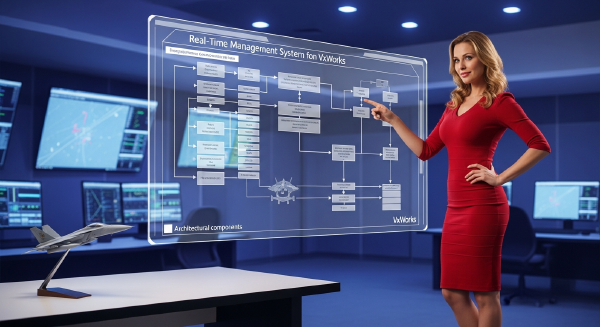
Wind River’s vxworks7-ros2-build project automates cross-compilation of ROS 2 and its dependencies against the VxWorks SDK.
Supported ROS 2 distributions include:
- Humble Hawksbill
- Jazzy Jalisco
- Rolling Ridley
Currently supported targets include:
- QEMU x86_64
- Raspberry Pi 4
The build system relies on:
- Docker-based reproducible environments
colconbuild tooling- Clang-based VxWorks cross-compilation
- Custom compatibility patches for ROS 2 packages
The repository structure includes middleware, dependencies, and robotics packages:
pkg/
├── ros2
├── turtlebot3
├── asio
├── tinyxml2
├── python
├── eigen
└── unixextra
Generated runtime artifacts are exported into deployable filesystem trees:
output/export/
├── deploy/
└── root/
The deployable runtime contains:
- ROS 2 binaries
- Shared libraries
- Python runtime components
- CLI tooling
- Example ROS 2 applications
This architecture simplifies deployment to both virtualized and physical VxWorks targets.
🔧 Cross-Compilation Workflow #
The recommended workflow uses Docker containers to ensure reproducible builds across development environments.
Build Environment Initialization #
First, developers build a Docker image for the desired ROS 2 distribution:
docker build --no-cache -t vxros2build:jazzy Docker/24.04/vxros2build/.The VxWorks SDK is then mounted into the container environment:
docker run -ti \
-v ~/Downloads/wrsdk:/wrsdk \
-v $PWD:/work \
vxros2build:jazzy
Inside the container:
source /wrsdk/sdkenv.sh
make
The build pipeline automatically:
- Downloads ROS 2 dependencies
- Applies VxWorks compatibility patches
- Cross-compiles middleware
- Builds ROS 2 packages
- Exports deployable runtime images
The environment uses Wind River’s Clang-based toolchain:
wr-cc
wr-c++
CMake integration is handled through a dedicated toolchain file:
-DCMAKE_TOOLCHAIN_FILE=/work/buildspecs/cmake/toolchain.cmakeThis allows many Linux-oriented CMake projects to compile under VxWorks with minimal modification.
🖥️ Running ROS 2 on QEMU-Based VxWorks #
One of the most practical advantages of the platform is the ability to prototype full robotics systems using QEMU before deploying to physical hardware.
A bootable image containing ROS 2 runtime artifacts is generated with:
make imageQEMU can then boot the VxWorks kernel directly:
qemu-system-x86_64 \
-machine q35 \
-cpu Nehalem \
-kernel vxWorks
Networking is typically configured using TAP interfaces, enabling DDS communication between VxWorks-based ROS 2 nodes and Linux hosts.
Inside the VxWorks shell:
-> ls "/usr"developers can verify the deployed ROS 2 runtime filesystem.
This approach significantly accelerates development, validation, and middleware testing before hardware integration.
🚀 Executing ROS 2 Applications on VxWorks #
ROS 2 C++ applications run directly as VxWorks RTPs (Real-Time Processes).
Example:
/usr/lib/examples_rclcpp_minimal_timer/timer_lambdaExpected output:
[INFO] [minimal_timer]: Hello, world!Python-based ROS 2 nodes are also supported:
python3 ros2 run demo_nodes_py talkerThis demonstrates that VxWorks can successfully host:
- DDS middleware
- Python interpreters
- ROS 2 CLI tooling
- Distributed robotics applications
while maintaining deterministic RTOS scheduling behavior.
🔐 ROS 2 Security and SROS2 Integration #
Security is increasingly critical for connected autonomous systems.
The platform supports:
- SROS2
- DDS Security
- Certificate-based authentication
- Encrypted node communication
Example runtime configuration:
set env "ROS_SECURITY_ENABLE=true"Applications can launch with enclave isolation:
python3 ros2 run demo_nodes_cpp talker \
--ros-args --enclave /talker_listener/talker
These capabilities align with VxWorks 7 security features including:
- Secure boot
- Process isolation
- Memory separation
- Hardened networking stacks
For defense, aerospace, and industrial robotics, combining deterministic execution with secure middleware communication is increasingly mandatory.
📈 Why VxWorks Matters for Real-Time Robotics #
Most ROS 2 deployments on Linux depend on PREEMPT_RT kernels to approximate soft real-time behavior. While effective for many robotics workloads, Linux-based systems still experience:
- Scheduler jitter
- Shared kernel contention
- Non-deterministic interrupt handling
- Latency variation under load
VxWorks addresses these issues through:
- Deterministic scheduling
- Fixed interrupt response times
- Strict priority enforcement
- Partitioned runtime environments
These guarantees are essential for:
- Flight-control robotics
- Autonomous drones
- Industrial motion control
- Surgical robotics
- Defense-grade autonomous systems
In these environments, bounded latency is not optional.
🤖 Edge AI and Embedded Robotics Convergence #
The integration of ROS 2 with VxWorks reflects a broader architectural shift in robotics and edge computing.
Modern autonomous systems increasingly combine:
- Real-time control loops
- AI inference pipelines
- Sensor fusion
- Distributed middleware
- Functional safety
- Cybersecurity
Within this architecture:
- VxWorks provides deterministic execution infrastructure
- ROS 2 supplies modular robotics middleware
- DDS enables distributed coordination
- AI accelerators handle inference workloads
This model is increasingly relevant for:
- Autonomous mobile robots (AMRs)
- Industrial cobots
- Space robotics
- Autonomous defense systems
- Intelligent edge platforms
As edge AI systems continue to evolve, the separation between embedded RTOS infrastructure and robotics middleware is becoming increasingly narrow.
🧠 The 2026 Robotics Architecture Model #
By 2026, heterogeneous robotics architectures have become the dominant deployment model across industrial and autonomous systems.
A common pattern now includes:
- Linux for orchestration and high-level services
- RTOS platforms for deterministic control paths
- AI accelerators for machine learning inference
- DDS middleware for distributed communication
Within this stack, VxWorks 7 operates as the deterministic execution layer beneath modern robotics middleware rather than as a direct Linux replacement.
This approach is especially valuable in environments requiring:
- Functional safety certification
- Predictable timing behavior
- Long lifecycle maintenance
- Security hardening
- High operational reliability
The significance of ROS 2 support on VxWorks extends beyond middleware compatibility. It demonstrates that modern robotics frameworks can now operate directly atop a certified hard real-time operating system without abandoning the broader ROS ecosystem.
📚 References #
- Wind River VxWorks ROS 2 Build Repository
- Wind River Labs SDK Downloads
- ROS 2 Documentation
- Wind River Official Website