VxWorks UDP Socket Programming: Design, Pitfalls and Refactoring
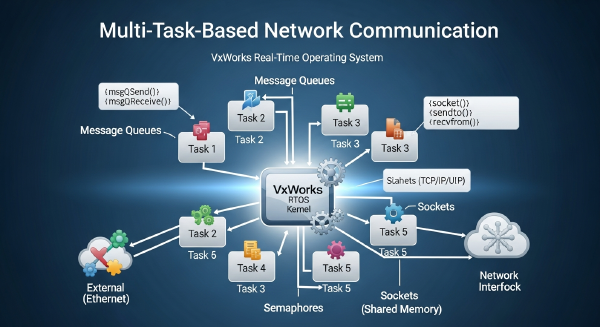
UDP (User Datagram Protocol) is a lightweight, connectionless transport protocol that operates directly above IP. Its minimal protocol overhead makes it well suited to real-time control, telemetry, diagnostics, and low-latency data exchange in embedded VxWorks systems.
However, production-quality UDP code requires more than simply wrapping socket(), sendto(), and recvfrom(). Correct handling of datagram boundaries, socket ownership, timeout conversion, peer addresses, error paths, and API semantics is essential for predictable behavior.
This guide reviews a typical VxWorks UDP implementation, identifies its primary design problems, and presents a refactored implementation with clearer ownership and error semantics.
🔌 UDP Socket Lifecycle and Execution Model #
The fundamental UDP server and client lifecycles are similar, but binding behavior differs.
| Lifecycle Phase | UDP Server | UDP Client |
|---|---|---|
| Creation | socket(AF_INET, SOCK_DGRAM, 0) |
socket(AF_INET, SOCK_DGRAM, 0) |
| Binding | Explicit bind() to local IP/port |
Usually optional |
| Transfer | recvfrom() / sendto() |
sendto() / recvfrom() |
| Peer selection | Per-datagram source/destination | Destination supplied to sendto() |
| Teardown | close() |
close() |
A UDP socket does not establish a persistent transport connection. Each datagram is independently addressed, transmitted, and received.
For a server, bind() normally establishes the local endpoint. A client can often allow the kernel to select an ephemeral local port automatically when the first outbound datagram is transmitted.
⚠️ Code Review: Critical Problems in the Original Design #
Several issues in the original implementation can produce incorrect behavior or poor network performance.
Inverted net_bind() Success Test
#
The original net_bind() implementation returned 1 when bind() succeeded, while the application interpreted 0 as success.
That creates an inverted result:
if (net_bind(...) == 0) {
    printf("success");
}
The application therefore reports success when the operation actually fails.
A conventional C API should return 0 for success and a negative value for failure, or consistently use named status constants such as UDP_OK and UDP_ERROR.
UDP Fragmentation Is Not TCP-Style Segmentation #
A common mistake is to treat a large UDP payload like a TCP byte stream and split it into arbitrary chunks.
The original implementation attempted to transmit datagrams as large as 65,507 bytes. Although this is close to the theoretical maximum UDP payload over IPv4, it is unsuitable for normal Ethernet networks.
With a standard 1,500-byte Ethernet MTU, an IPv4 UDP datagram should normally be limited to:
1500 - 20-byte IPv4 header - 8-byte UDP header = 1472 bytesA larger datagram can be fragmented at the IP layer. Fragmentation increases loss sensitivity because losing one fragment causes the complete UDP datagram to become unusable.
For latency-sensitive embedded systems, keeping application datagrams below the path MTU is generally preferable.
Incorrect timeval Construction
#
A timeout implementation such as:
tv.tv_usec = ms * 1000;can generate an invalid timeval when the supplied timeout is 1,000 ms or greater.
The correct conversion separates whole seconds from the remaining milliseconds:
tv.tv_sec = timeout_ms / 1000;
tv.tv_usec = (timeout_ms % 1000) * 1000;
This guarantees that tv_usec remains below one million.
Overwriting Socket Context with Peer Information #
Using the same address field for both local/remote configuration and recvfrom() output creates hidden state mutation.
The address returned by recvfrom() describes the sender of the received datagram, not the configured destination of future transmissions.
The refactored implementation therefore keeps:
local_addrfor the socket’s local endpoint.remote_addrfor the default transmission destination.src_addras an explicit output parameter for the sender of an incoming datagram.
This separation makes the API easier to reason about and safer for long-running tasks.
🧱 Refactored UDP API #
The following interface separates socket state from per-packet addressing and provides explicit status codes.
udp.h
#
#ifndef _UDP_H
#define _UDP_H

#include <vxWorks.h>
#include <sockLib.h>
#include <inetLib.h>
#include <taskLib.h>
#include <stdio.h>
#include <string.h>
#include <selectLib.h>

#define UDP_MAX_PAYLOAD    1472
#define UDP_OK             0
#define UDP_ERROR          -1
#define UDP_TIMEOUT        -2

typedef struct {
    int sd;
    struct sockaddr_in local_addr;
    struct sockaddr_in remote_addr;
} UdpData;

int udp_init(UdpData *data, const char *ipAddr, int port);
int net_bind(UdpData *data, const char *ipAddr, int port);

int udp_send(const UdpData *data, const void *buff, size_t len);

int udp_recv(UdpData *data,
             void *buff,
             size_t max_len,
             int timeout_ms);

int udp_sendto(const UdpData *data,
               const void *buff,
               size_t len,
               const struct sockaddr_in *dest_addr);

int udp_recvfrom(const UdpData *data,
                 void *buff,
                 size_t max_len,
                 struct sockaddr_in *src_addr,
                 int timeout_ms);

void udp_close(UdpData *data);

#endif /* _UDP_H */
UDP_MAX_PAYLOAD is intentionally set to 1,472 bytes for a conventional Ethernet/IPv4 path. Applications operating across networks with different MTUs should derive the effective payload limit from the actual path rather than treating 1,472 bytes as a universal maximum.
⚙️ UDP Socket Implementation #
Socket Initialization #
The initialization routine creates the socket, configures address reuse, and stores the default remote endpoint.
#include "udp.h"

int udp_init(UdpData *data, const char *ipAddr, int port)
{
    int sd;
    int optval = 1;

    if (data == NULL)
        return UDP_ERROR;

    memset(data, 0, sizeof(UdpData));
    data->sd = -1;

    sd = socket(AF_INET, SOCK_DGRAM, 0);
    if (sd < 0) {
        perror("udp_init: socket creation failed");
        return UDP_ERROR;
    }

    if (setsockopt(sd,
                   SOL_SOCKET,
                   SO_REUSEADDR,
                   (char *)&optval,
                   sizeof(optval)) < 0) {
        perror("udp_init: setsockopt SO_REUSEADDR failed");
        close(sd);
        return UDP_ERROR;
    }

    data->sd = sd;

    memset(&data->remote_addr, 0, sizeof(data->remote_addr));
    data->remote_addr.sin_family = AF_INET;
    data->remote_addr.sin_port = htons((u_short)port);

    if (ipAddr != NULL && strlen(ipAddr) > 0) {
        data->remote_addr.sin_addr.s_addr =
            inet_addr((char *)ipAddr);
    } else {
        data->remote_addr.sin_addr.s_addr =
            htonl(INADDR_ANY);
    }

    return UDP_OK;
}
Initializing sd to -1 immediately after clearing the structure makes the socket lifecycle explicit and prevents accidental attempts to close or use descriptor zero as a valid socket.
Binding the Local Endpoint #
net_bind() configures the local address independently from the remote destination.
int net_bind(UdpData *data, const char *ipAddr, int port)
{
    if (data == NULL || data->sd < 0)
        return UDP_ERROR;

    memset(&data->local_addr, 0, sizeof(data->local_addr));

    data->local_addr.sin_family = AF_INET;
    data->local_addr.sin_port = htons((u_short)port);

    if (ipAddr == NULL || strlen(ipAddr) == 0) {
        data->local_addr.sin_addr.s_addr =
            htonl(INADDR_ANY);
    } else {
        data->local_addr.sin_addr.s_addr =
            inet_addr((char *)ipAddr);

        if (data->local_addr.sin_addr.s_addr == INADDR_NONE)
            return UDP_ERROR;
    }

    if (bind(data->sd,
             (struct sockaddr *)&data->local_addr,
             sizeof(data->local_addr)) < 0) {
        perror("net_bind: bind failed");
        return UDP_ERROR;
    }

    return UDP_OK;
}
The function now follows the conventional contract:
UDP_OK     = successful bind
UDP_ERROR  = failure
This eliminates ambiguity at the application layer.
📤 UDP Transmission #
The convenience udp_send() function uses the configured remote_addr.
int udp_send(const UdpData *data, const void *buff, size_t len)
{
    if (data == NULL)
        return UDP_ERROR;

    return udp_sendto(data, buff, len, &data->remote_addr);
}
The lower-level udp_sendto() function accepts an explicit destination.
int udp_sendto(const UdpData *data,
               const void *buff,
               size_t len,
               const struct sockaddr_in *dest_addr)
{
    int bytes_sent;

    if (data == NULL ||
        data->sd < 0 ||
        buff == NULL ||
        dest_addr == NULL) {
        return UDP_ERROR;
    }

    if (len > UDP_MAX_PAYLOAD) {
        printf("udp_sendto warning: payload size (%g KB) "
               "exceeds recommended MTU payload (%d bytes)\n",
               (double)len / 1024.0,
               UDP_MAX_PAYLOAD);
    }

    bytes_sent = sendto(
        data->sd,
        (const char *)buff,
        len,
        0,
        (const struct sockaddr *)dest_addr,
        sizeof(struct sockaddr_in));

    if (bytes_sent < 0) {
        perror("udp_sendto: sendto failed");
        return UDP_ERROR;
    }

    return bytes_sent;
}
The function deliberately does not fragment a large application buffer into multiple UDP datagrams.
If an application needs to transmit data larger than the safe datagram size, fragmentation should be implemented at the application protocol layer, where sequence numbers, message identifiers, lengths, and retransmission policy can be explicitly controlled.
📥 UDP Reception and Timeout Handling #
The receive path uses select() to implement an optional millisecond timeout before calling recvfrom().
int udp_recvfrom(const UdpData *data,
                 void *buff,
                 size_t max_len,
                 struct sockaddr_in *src_addr,
                 int timeout_ms)
{
    fd_set readfds;
    struct timeval tv;
    struct timeval *ptimeval = NULL;
    int select_ret;
    socklen_t addr_len = sizeof(struct sockaddr_in);
    int bytes_recvd;

    if (data == NULL ||
        data->sd < 0 ||
        buff == NULL ||
        src_addr == NULL) {
        return UDP_ERROR;
    }

    FD_ZERO(&readfds);
    FD_SET(data->sd, &readfds);

    if (timeout_ms >= 0) {
        tv.tv_sec = timeout_ms / 1000;
        tv.tv_usec = (timeout_ms % 1000) * 1000;
        ptimeval = &tv;
    }

    select_ret = select(
        data->sd + 1,
        &readfds,
        NULL,
        NULL,
        ptimeval);

    if (select_ret < 0) {
        perror("udp_recvfrom: select error");
        return UDP_ERROR;
    }

    if (select_ret == 0)
        return UDP_TIMEOUT;

    if (FD_ISSET(data->sd, &readfds)) {
        bytes_recvd = recvfrom(
            data->sd,
            (char *)buff,
            max_len,
            0,
            (struct sockaddr *)src_addr,
            &addr_len);

        if (bytes_recvd < 0) {
            perror("udp_recvfrom: recvfrom error");
            return UDP_ERROR;
        }

        return bytes_recvd;
    }

    return UDP_ERROR;
}
The timeout semantics are straightforward:
timeout_ms |
Behavior |
|---|---|
< 0 |
Wait indefinitely |
0 |
Poll without blocking |
> 0 |
Wait for the specified number of milliseconds |
| No packet before timeout | Return UDP_TIMEOUT |
The sender address is returned through src_addr, preventing the receive operation from modifying the persistent socket context.
Convenience Receive Function #
For applications that do not need the sender address, udp_recv() can hide that implementation detail.
int udp_recv(UdpData *data,
             void *buff,
             size_t max_len,
             int timeout_ms)
{
    struct sockaddr_in peer_addr;

    return udp_recvfrom(
        data,
        buff,
        max_len,
        &peer_addr,
        timeout_ms);
}
This preserves a simple API while maintaining the safer internal separation between socket configuration and per-packet metadata.
🧹 Socket Cleanup #
The close operation should be idempotent with respect to the socket descriptor state.
void udp_close(UdpData *data)
{
    if (data != NULL && data->sd >= 0) {
        close(data->sd);
        data->sd = -1;
    }
}
Resetting sd to -1 after close() prevents accidental reuse of a stale descriptor.
🖥️ Corrected VxWorks Server Integration #
The application layer should now test UDP_OK rather than relying on an inverted Boolean convention.
#include "udp.h"

void udp_server_task(void)
{
    UdpData server_ctx;
    char rx_buffer[1024];
    struct sockaddr_in client_addr;
    int status;
    int port = 2300;

    if (udp_init(&server_ctx, NULL, port) != UDP_OK) {
        printf("Server init failed\n");
        return;
    }

    if (net_bind(&server_ctx, NULL, port) != UDP_OK) {
        printf("Server bind failed\n");
        udp_close(&server_ctx);
        return;
    }

    printf("UDP Server listening on port %d...\n", port);

    while (1) {
        status = udp_recvfrom(
            &server_ctx,
            rx_buffer,
            sizeof(rx_buffer) - 1,
            &client_addr,
            1000);

        if (status > 0) {
            rx_buffer[status] = '\0';

            printf("Received from %s:%d -> %s\n",
                   inet_ntoa(client_addr.sin_addr),
                   ntohs(client_addr.sin_port),
                   rx_buffer);

            /* Echo reply */
            udp_sendto(
                &server_ctx,
                "ACK",
                3,
                &client_addr);

        } else if (status == UDP_TIMEOUT) {

            /* Periodic task activity */
            taskDelay(sysClkRateGet() / 10);

        } else {

            printf("Receive error detected, "
                   "exiting loop\n");
            break;
        }
    }

    udp_close(&server_ctx);
}
The resulting server has a clean lifecycle:
udp_init()
    |
    v
net_bind()
    |
    v
udp_recvfrom()
    |
    +---- UDP_TIMEOUT ----> periodic processing
    |
    +---- packet ---------> application processing
    |                          |
    |                          v
    |                     udp_sendto()
    |
    +---- error ----------> cleanup
    |
    v
udp_close()
📐 Production Design Considerations #
Keep Datagram Size Explicit #
The 1,472-byte recommendation assumes standard Ethernet MTU and IPv4 headers. It is not a universal UDP limit.
If the system operates over VLANs, tunnels, VPNs, jumbo frames, cellular links, or other encapsulations, the effective path MTU can differ.
For tightly controlled embedded networks, defining an application-specific maximum datagram size is often preferable to relying on IP fragmentation.
Treat UDP Delivery as Unreliable #
UDP provides no built-in guarantee of:
- delivery,
- ordering,
- duplicate suppression,
- retransmission,
- congestion control, or
- end-to-end integrity beyond the UDP checksum mechanism.
If an application requires reliability, those semantics must be implemented above UDP or supplied by another transport protocol.
Avoid Hidden Mutable State #
A reusable UDP context should contain relatively stable socket configuration. Per-message state should be supplied as function arguments or returned through output parameters.
This is particularly important when the same socket is accessed by multiple VxWorks tasks. If concurrent access is required, the application should also establish explicit ownership or synchronization rules around socket operations and shared buffers.
Validate Application Payloads #
For binary protocols, never treat received data as a C string unless the application protocol explicitly defines it as such.
The server example reserves one byte:
sizeof(rx_buffer) - 1and explicitly appends:
rx_buffer[status] = '\0';This is appropriate for text payloads but should not be applied to arbitrary binary data.
📝 Key Takeaways #
A robust VxWorks UDP implementation should follow several core principles:
- Return a consistent status convention such as
UDP_OK == 0. - Keep UDP datagrams within an appropriate path-MTU budget.
- Do not treat UDP like a TCP byte stream.
- Convert millisecond timeouts into valid
timevalfields. - Keep local, remote, and received-peer addresses separate.
- Avoid modifying persistent socket context inside
recvfrom(). - Return explicit timeout and error states to the application.
- Reset socket descriptors after
close(). - Implement application-level fragmentation and reliability only when the protocol requires them.
- Define task ownership and synchronization when sockets are shared across VxWorks tasks.
The resulting design is simpler to test, easier to maintain, and substantially safer for long-running embedded networking workloads than a UDP wrapper that mixes socket state, peer state, packet handling, and application semantics.