PowerPC P2020 SMP on VxWorks: Boot, Scheduling, and IPI
Modern embedded signal-processing systems require deterministic real-time behavior, high throughput, and reliable parallel execution. Multi-core processors address these demands by enabling concurrent task execution with shared resources. This article presents a complete implementation of multi-core communication on a PowerPC P2020 dual-core SoC running VxWorks 6.9 in SMP mode, covering architecture selection, boot synchronization, scheduling strategy, and inter-core communication using IPI and shared memory.
🔍 Multi-Core Architecture Models #
Embedded multi-core systems typically adopt one of three models:
- AMP (Asymmetric Multi-Processing): Each core runs an independent OS instance. Provides strong isolation but limits flexibility and resource utilization.
- SMP (Symmetric Multi-Processing): A single OS instance manages all cores with a unified memory space. Enables dynamic load balancing and efficient communication.
- BMP (Bounded Multi-Processing): A hybrid approach combining shared and partitioned resources, increasing design complexity.
This implementation uses SMP to maximize CPU utilization and minimize communication latency while maintaining real-time guarantees.
🛠️ Hardware Platform Overview #
The PowerPC P2020 integrates dual e500v2 cores (up to 1.2 GHz), a DDR2/3 memory controller, an OpenPIC interrupt controller, and a DMA engine. These components directly enable efficient multi-core operation:
- Shared DDR memory supports high-bandwidth data exchange
- OpenPIC provides inter-processor interrupt (IPI) capability
- DMA offloads large data transfers from CPU cores
🚀 SMP System Architecture Design #
The system operates under a single VxWorks 6.9 SMP instance. Logical roles are assigned for clarity:
- Core0: control plane (command handling, device management, scheduling coordination)
- Core1: data plane (signal processing, filtering, algorithm execution)
Despite role separation, both cores share the same scheduler and memory space, allowing dynamic workload redistribution.
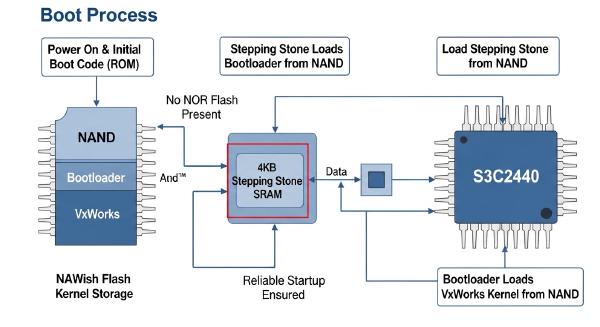
🔄 Multi-Core Boot Flow #
The boot process ensures synchronized initialization across both cores:
- Bootloader initializes hardware resources, including clocks, memory, and interrupt controller
- Core0 boots as the primary core
- Core0 configures Core1 startup context and releases it from reset
- A shared-memory flag signals readiness between cores
- VxWorks kernel initializes SMP services, including scheduling and IPI handling
- Application tasks are created and scheduled
Hardware semaphores and shared flags ensure deterministic startup, with inter-core synchronization latency maintained within microsecond scale.
📋 Task Scheduling in VxWorks SMP #
VxWorks 6.9 SMP uses a priority-based preemptive scheduler with support for multiple policies. The selected strategy combines affinity and load balancing:
- Tasks with explicit affinity are bound to specific cores
- Unbound tasks are scheduled from a global queue
- The scheduler assigns tasks to the least-loaded core
This model achieves high CPU utilization while maintaining predictable execution. Context-switch overhead remains minimal, supporting real-time constraints.
🔗 Inter-Core Communication Using IPI and Shared Memory #
Efficient inter-core communication is critical for high-frequency data exchange. The design combines:
- IPI (Inter-Processor Interrupt) for event notification
- Shared memory for data transfer
Communication flow (Core0 → Core1):
- Core0 locks a mutex and checks buffer availability
- Data is written to shared memory and a flag is set
- Core0 triggers an IPI to Core1
- Core1 ISR reads the data, clears the flag, and releases the lock
- Processing continues in task context
Synchronization is implemented using VxWorks semaphores (semTake / semGive), ensuring mutual exclusion and data consistency. This approach minimizes latency compared to message-queue-based mechanisms.
✅ Performance Evaluation #
System performance was validated in a signal-processing workload:
- Dual-core SMP reduced processing time significantly compared to single-core execution
- CPU utilization exceeded 90% under load
- Inter-core communication latency remained in the microsecond range
- Long-duration stability testing showed no deadlocks or scheduling anomalies
Cache optimization techniques, including data alignment and prefetching, improved L2 cache efficiency and overall throughput.
📌 Conclusion #
The PowerPC P2020 implementation with VxWorks 6.9 SMP demonstrates how efficient boot coordination, adaptive scheduling, and low-latency inter-core communication can significantly improve system performance. The combination of IPI signaling and shared memory provides a scalable and deterministic communication model suitable for real-time embedded systems.
This design serves as a practical reference for extending SMP architectures to higher core counts while preserving performance, reliability, and real-time behavior.
Reference: PowerPC P2020 SMP on VxWorks: Boot, Scheduling, and IPI