Linux and Smart Driving: Building the Software-Defined Vehicle
The automotive industry is undergoing a fundamental transformation. As vehicles become software-defined, the competitive advantage of a car is increasingly determined not only by its mechanical design or hardware configuration, but by the software running underneath it.
Artificial intelligence, intelligent driving, connectivity, and centralized vehicle computing are turning modern vehicles into highly complex software platforms. Some estimates put the software footprint of a modern vehicle at nearly 700 million lines of code.
Supporting that enormous software stack is the operating system.
Linux has gradually moved from a peripheral embedded operating system into an increasingly important platform for automotive intelligent driving. But automotive software has requirements that go far beyond conventional embedded development. Safety, security, reliability, long-term maintenance, and hardware integration all become critical.
This raises a fundamental question:
How did Linux evolve from an open-source “guerrilla” platform into a serious foundation for software-defined vehicles, and how can its limitations in safety-critical environments be addressed?
🚗 Software-Defined Vehicles Are Changing the Automotive Industry #
The concept of the Software-Defined Vehicle (SDV) represents a fundamental shift in automotive engineering.
In a traditional vehicle, functionality is primarily determined by mechanical systems and fixed hardware configurations. In an SDV, software increasingly determines how the vehicle behaves, how features are delivered, and how the platform evolves over time.
The transformation can be summarized as:
Traditional Vehicle

Mechanical Systems
       │
       ▼
Fixed Electronic Hardware
       │
       ▼
Fixed Software Functions


Software-Defined Vehicle

Hardware Platform
       │
       ▼
Operating System
       │
       ▼
Software Platform
       │
       ├── AI
       ├── Intelligent Driving
       ├── Connectivity
       ├── Infotainment
       └── Vehicle Services
              │
              ▼
      Continuous Evolution
As more vehicle functionality moves into software, the underlying operating system becomes increasingly important.
From Embedded Systems to Intelligent Vehicles #
The rise of Linux in embedded computing was not inevitable.
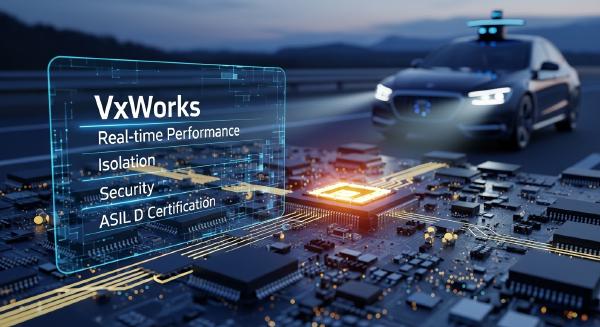
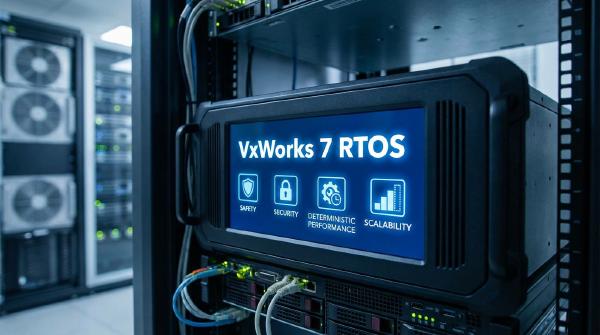
In the early embedded market, proprietary real-time operating systems such as VxWorks from Wind River held a strong position. Meanwhile, hardware platforms were highly fragmented, with architectures including ARM, StrongARM, and MIPS competing across different applications.
Linux benefited from its open development model, broad hardware support, extensive developer ecosystem, and ability to adapt to rapidly changing hardware platforms.
Over time, these advantages allowed Linux to move from a relatively unconventional choice into a mainstream embedded software platform.
Automotive intelligent driving represents another step in that evolution.
🛡️ Three Core Requirements for an Automotive Operating System #
The operating system sits at the center of a modern intelligent vehicle.
It manages computing resources, provides services to applications, coordinates hardware, and supports the software ecosystem above it.
In an intelligent-driving environment, three requirements become particularly important:
Efficiency, Security, and Stability
These requirements are interconnected.
A system that is fast to develop but insecure is unsuitable for connected vehicles. A secure platform that is difficult to maintain can become a long-term liability. And neither matters if the underlying system is unreliable in safety-critical situations.
⚙️ Efficient Development Is Essential #
The software footprint of vehicles has expanded dramatically.
The figures cited in the source material estimate that automotive software grew from approximately 100 million lines of code in 2015 to roughly 700 million lines by 2025.
That represents nearly a sevenfold increase in one decade.
The implication is obvious: automotive companies cannot continue scaling development simply by adding more engineers and writing more code.
They need reusable platforms, development tools, middleware, automation, hardware abstraction, and mature operating-system infrastructure.
A modern automotive OS therefore needs to provide:
- Broad programming-language support
- Mature development tools
- Flexible hardware integration
- Stable APIs
- Reusable system components
- Efficient debugging and deployment workflows
- Long-term maintainability
Linux’s large ecosystem gives it a significant advantage in this area.
🔐 Security Is Becoming a System-Level Requirement #
More software also means a larger attack surface.
Every additional component can potentially introduce vulnerabilities, while connected vehicles expose software systems to external networks and services.
The source material cites more than one million malicious attacks against vehicle network platforms since early 2022, illustrating the scale of the challenge.
Security therefore cannot be treated as an application-level feature added near the end of development.
It needs to be integrated into the entire software lifecycle:
Source Code
    │
    ▼
Build System
    │
    ▼
Security Scanning
    │
    ▼
Package / OS Hardening
    │
    ▼
System Validation
    │
    ▼
Deployment
    │
    ▼
CVE Monitoring
    │
    ▼
Patch + Revalidation
    │
    └──────────► Continuous Lifecycle
For automotive platforms expected to remain in production for many years, vulnerability management and long-term maintenance can be just as important as initial development.
🧱 Stability Is the Foundation #
An automotive operating system effectively functions as part of the vehicle’s central nervous system.
A conventional desktop application crash may be inconvenient.
An operating-system failure inside a safety-critical vehicle subsystem can have much more serious consequences.
The OS therefore needs predictable behavior under:
- High CPU utilization
- Heavy I/O
- Concurrent workloads
- Hardware faults
- Network interruptions
- Software failures
- Long operating lifetimes
This is one reason automotive Linux adoption requires considerably more engineering than simply installing a standard desktop Linux distribution onto automotive hardware.
🐧 Linux Brings Major Advantages—and Major Challenges #
Linux naturally satisfies many of the requirements for rapid automotive software development.
Its advantages include:
- A mature open-source ecosystem
- Broad hardware support
- Extensive programming-language and tooling support
- Unix-compatible APIs
- Flexible platform integration
- Large developer and vendor communities
- A highly customizable kernel and userspace
Its architecture also supports multitasking and multi-user operation, allowing multiple applications and services to share system resources.
These characteristics make Linux a powerful foundation for complex automotive software.
But automotive systems introduce requirements that ordinary embedded or server workloads do not always impose.
⚠️ Functional Safety Is Linux’s Major Hurdle #
The biggest challenge is not whether Linux can run on automotive hardware.
It can.
The harder question is whether a particular Linux-based platform can satisfy the strict requirements of functional safety (FuSa) for a given vehicle system.
Several factors complicate this process.
Open-Source Complexity #
Linux’s open development model is one of its greatest strengths.
But from a safety-engineering perspective, the enormous number of contributors, packages, configurations, and code paths creates additional verification and maintenance challenges.
Automotive manufacturers need controlled configurations, traceability, validation processes, vulnerability management, and predictable release policies.
The issue is therefore not simply that Linux is open source.
The real challenge is transforming a highly dynamic open-source codebase into a controlled, validated, production-grade platform.
Monolithic Kernel Architecture #
Linux uses a monolithic kernel architecture.
This provides substantial performance and functionality, but it also means that a large amount of system functionality operates within the kernel environment.
For safety-critical applications, this can complicate:
- Isolation
- Deterministic behavior
- Fault containment
- Long-term maintenance
- Real-time requirements
- Certification processes
Linux can be deeply customized to address specific requirements, but doing so requires considerable engineering expertise.
The Customization Burden #
The Linux kernel contains tens of millions of lines of code.
Automotive teams rarely need every subsystem.
Removing unnecessary functionality, hardening the remaining components, integrating hardware-specific drivers, and validating the resulting platform can become a substantial engineering project.
The challenge can be summarized as:
Upstream Linux
      │
      ▼
Select Required Components
      │
      ▼
Remove Unnecessary Code
      │
      ▼
Hardware / BSP Integration
      │
      ▼
Security Hardening
      │
      ▼
Real-Time Optimization
      │
      ▼
Functional Safety Process
      │
      ▼
Production Automotive Platform
For many development teams, this is where commercial Linux platforms become attractive.
🏗️ Open Source Needs a “Cathedral” for Critical Systems #
Linux development is often associated with the “bazaar” model: an open ecosystem in which many developers and organizations collaborate, experiment, and contribute.
That model is extremely effective for innovation.
But automotive systems often require another set of characteristics:
- Controlled quality
- Predictable releases
- Long-term support
- Professional engineering
- Security maintenance
- Validation
- Documentation
- Certification assistance
This resembles the “cathedral” model, where a structured organization turns raw materials into a controlled production system.
The combination of the two approaches is particularly powerful for safety-sensitive industries.
Open-Source Community
        │
        ▼
   Linux "Bazaar"
        │
        │ Innovation
        │ Hardware Support
        │ Ecosystem
        ▼
Commercial Engineering
        │
        │ Hardening
        │ Validation
        │ Lifecycle Support
        ▼
Automotive Production Platform
🏢 Wind River’s Role in Automotive Linux #
Wind River has more than four decades of experience in embedded and intelligent-edge software.
Its history is closely associated with safety- and reliability-sensitive systems.
The company’s VxWorks platform has been used in critical infrastructure and aerospace applications, including NASA-related missions. That background has shaped Wind River’s emphasis on predictable behavior, reliability, security, and lifecycle management.
In 2005, Wind River introduced its first complete Linux platform, Platform for Network Equipment (PNE).
The platform demonstrated an important concept: open-source Linux could be combined with professionally engineered networking middleware and application components.
The same philosophy has become increasingly relevant to automotive software.
🔧 Wind River Linux: Turning Linux Into a Production Platform #
Wind River Linux is positioned as a commercially engineered Linux foundation for embedded and automotive applications.
The objective is not to replace Linux’s open ecosystem, but to make it easier for organizations to deploy Linux where reliability, security, and lifecycle management are critical.
Deep Customization and Hardening #
Automotive platforms frequently require a carefully controlled Linux configuration.
Wind River can provide deep kernel customization and trimming to help address specific requirements around:
- Real-time behavior
- Resource utilization
- Hardware integration
- Security hardening
- Functional safety
- Platform stability
The commercial engineering layer also introduces controlled development and validation processes around the open-source foundation.
This is particularly valuable when an automotive OEM does not want to build an entire Linux engineering and maintenance organization internally.
🔒 Full-Lifecycle Security With Wind River Studio Linux Services #
Automotive software does not become secure simply because it passed a security review at launch.
New vulnerabilities are continuously discovered.
A production platform therefore requires a continuous security lifecycle.
Wind River Studio Linux Services provide capabilities around:
CVE Lifecycle Management #
The process includes:
- Vulnerability identification
- Risk prioritization
- Patch management
- Tracking
- Validation
- Lifecycle monitoring
Automated Security Scanning #
Wind River Studio Security Scanning can identify large numbers of CVEs across software components.
The source material cites one customer environment where more than 1,500 CVEs were identified, including more than 80 high-risk vulnerabilities.
The value is not merely finding vulnerabilities.
The important part is turning that information into an actionable maintenance process.
Continuous Maintenance and Validation #
Automotive platforms require ongoing:
- Security updates
- Daily builds
- Testing
- Validation
- OS maintenance
- BSP maintenance
This approach reduces the risk of allowing technical debt to accumulate until the platform becomes difficult to update.
Visibility and Reporting #
Online dashboards can provide visibility into:
- Vulnerability status
- Patch progress
- Platform health
- Maintenance activities
This gives development and security teams a shared view of the platform’s lifecycle state.
🔄 Long-Term Maintenance Can Become a Hidden Cost #
One of the biggest challenges with embedded Linux is not getting the system running.
It is keeping the system healthy for years.
A platform may contain hundreds or thousands of software components, each with its own dependencies and vulnerability lifecycle.
Without an organized maintenance process, engineering teams can become trapped in a continuous cycle of:
New Vulnerability
      │
      ▼
Find Affected Package
      │
      ▼
Backport Patch
      │
      ▼
Resolve Dependencies
      │
      ▼
Rebuild Platform
      │
      ▼
Regression Testing
      │
      ▼
Release
      │
      ▼
Another Vulnerability
      │
      └──────────────► Repeat
For automotive organizations, the cost of this process can become substantial.
A managed lifecycle can allow internal engineering teams to spend more time building differentiated vehicle features instead of repeatedly maintaining the underlying OS.
🚘 Linux Is Moving Up the Automotive Software Stack #
The role of Linux in intelligent vehicles is also expanding beyond the basic operating-system layer.
Modern SDV platforms increasingly combine:
- High-Performance Computing (HPC)
- Intelligent driving
- ADAS
- V2X communication
- Vehicle connectivity
- Domain controllers
- Centralized computing
- Infotainment
The architecture is becoming increasingly similar to modern cloud and enterprise software stacks, where the operating system serves as the foundation for a much larger software ecosystem.
The analogy with the LAMP stack is useful.
The success of Linux in web infrastructure did not come from the kernel alone. It came from the combination of Linux with databases, web servers, programming languages, frameworks, tools, and developers.
Automotive Linux is following a similar path.
🤝 Ecosystem Collaboration Is the Key to SDV Adoption #
The future of software-defined vehicles will depend on more than individual operating systems.
Automakers need an ecosystem that connects:
Automaker
    │
    ├── Vehicle Hardware
    │
    ├── SoC Vendors
    │
    ├── Operating System
    │
    ├── Middleware
    │
    ├── AI / ADAS Software
    │
    ├── Cloud Services
    │
    └── Development & Security Tools
This ecosystem approach reduces duplicated engineering work and makes it easier to build complex vehicle platforms.
The source material identifies automakers including Hozon Auto, Zeekr, and NETA as examples of companies adopting Wind River Linux for next-generation SDV platforms, E/E architectures, and intelligent domain controllers.
More broadly, commercial Linux platforms can help automotive companies reduce the engineering risks associated with adopting open-source technologies in safety- and security-sensitive environments.
🌍 From “Guerrilla” Linux to Automotive Infrastructure #
Linux’s automotive journey can be understood as a gradual transition.
Open-Source Linux
       │
       ▼
Embedded Adoption
       │
       ▼
Commercial Engineering
       │
       ▼
Security + Hardening
       │
       ▼
Functional Safety Processes
       │
       ▼
Automotive Platforms
       │
       ▼
Software-Defined Vehicles
The key lesson is that Linux does not need to become a fundamentally different operating system to succeed in automotive.
Instead, the surrounding engineering system needs to evolve.
Open-source innovation provides the foundation.
Professional engineering adds:
- Controlled configuration
- Security maintenance
- Hardware integration
- Validation
- Lifecycle management
- Support
- Safety processes
Together, these layers can turn a flexible general-purpose operating system into a production-grade automotive platform.
🏁 Linux Is Becoming a Foundation for the Software-Defined Vehicle #
The automotive industry’s transition toward software-defined vehicles is changing the role of the operating system.
A vehicle is no longer simply a collection of mechanical components controlled by embedded software.
It is becoming a distributed computing platform containing hundreds of millions of lines of code, AI workloads, connected services, intelligent driving systems, and increasingly centralized computing resources.
Linux is well positioned for this transformation because of its flexibility, hardware support, developer ecosystem, and enormous software base.
But automotive adoption requires more than simply choosing Linux.
Safety, security, stability, customization, validation, and long-term maintenance are the real thresholds.
This is where commercial platforms such as Wind River Linux can bridge the gap between the openness of the Linux ecosystem and the strict engineering requirements of automotive systems.
The broader lesson is similar to Linux’s rise in other industries: the operating system itself is only the foundation.
The real competitive advantage comes from the platform, tooling, lifecycle services, and ecosystem built around it.
As software increasingly defines how vehicles function, evolve, and differentiate themselves, Linux is moving from an embedded operating-system option toward something much more important:
a potential software foundation for the next generation of intelligent, connected, and software-defined vehicles.
ℹ️ About Wind River #
Wind River is a global provider of intelligent-edge software. For more than 40 years, the company has developed software platforms for systems that demand high levels of safety, security, reliability, and lifecycle support.
Its technology portfolio serves industries including automotive, aerospace, defense, industrial, medical, and telecommunications, combining software products with professional services, technical support, and a global partner ecosystem.