VxWorks Platforms 3.8: Architecture, Features, and RTOS Capabilities
Modern embedded systems demand deterministic performance, strong security, and scalable connectivity. As device complexity increases, developers must balance real-time constraints with networking, safety, and lifecycle management.
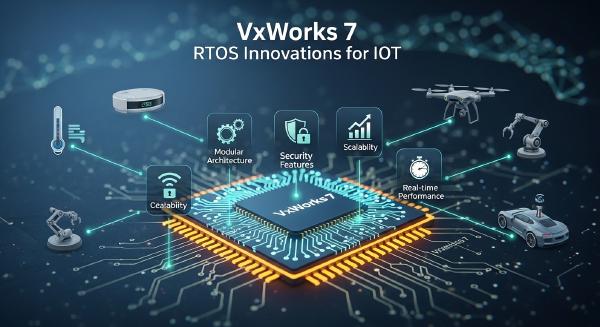
VxWorks Platforms 3.8 provides a fully integrated development and runtime environment that combines a commercial-grade RTOS, development tooling, and production-ready middleware into a unified solution for embedded systems.
🧩 Platform Overview #
VxWorks Platforms deliver a complete develop-and-run stack:
- Real-time operating system (VxWorks 6.8)
- Integrated development environment (Workbench 3.2)
- Pre-integrated middleware (networking, security, management)
This integration reduces system complexity, shortens development cycles, and improves system reliability.
Target Application Domains #
- Aerospace and defense
- Industrial automation
- Automotive systems
- Networking infrastructure
- Medical devices
- Consumer electronics
🏗️ Platform Variants #
VxWorks Platforms 3.8 includes multiple domain-specific configurations:
General Purpose Platform #
- Broad applicability across industries
- Balanced performance and flexibility
Automotive Platform #
- Optimized for low power and small footprint
- Suitable for ECUs, dashboards, and telematics
Consumer Devices Platform #
- Fast boot and memory-efficient runtime
- Designed for multimedia and handheld devices
Industrial Devices Platform #
- Strong connectivity and multimedia support
- Used in factory automation and instrumentation
Network Equipment Platform #
- High-performance packet processing
- Extensive security and protocol support
🚀 What’s New in Version 3.8 #
This release focuses on multicore scalability, networking enhancements, and toolchain improvements.
Core Updates #
- VxWorks 6.8 RTOS enhancements
- Improved memory protection and scalability
- Integrated hypervisor support
Toolchain Enhancements #
- Updated compilers (Wind River Compiler, GNU)
- VxWorks Simulator improvements
- Enhanced debugging and analysis tools
Networking Improvements #
- Zero-copy socket support
- Updated SSL with FIPS 140-2 compliance
- Enhanced web services (SOAP stack)
Multicore Communication #
- MIPC 2.0 for high-speed inter-core messaging
- Improved AMP/SMP coordination
⚙️ VxWorks 6.8 RTOS Architecture #
VxWorks is designed for deterministic, low-latency execution with high configurability.
Key Capabilities #
Memory Protection #
- Kernel and user-space isolation
- Real-Time Processes (RTPs) with independent memory spaces
- Support for multiple virtual memory models
Device Driver Framework #
- VxBus standardizes driver development
- Simplifies BSP portability and maintenance
Error Detection and Recovery #
- Stack overflow detection
- Memory corruption checks
- Configurable fault handling policies
File Systems #
- FAT-compatible dosFs
- Highly Reliable File System (HRFS) with transactional safety
Scalability #
- Source build system for footprint optimization
- Minimal kernel footprint (~75 KB)
🌐 Networking Stack #
VxWorks includes a production-grade networking stack supporting modern protocols and high-performance data paths.
Core Features #
- Dual-stack IPv4/IPv6
- Zero-copy networking (zbuf)
- SCTP, MPLS, DiffServ QoS
- Virtual routing and redundancy (VRRP)
Performance Optimizations #
- Hardware acceleration support
- Fast-path packet forwarding
- Embedded-ready protocol implementations
🧠 Multiprocessing Support (SMP & AMP) #
VxWorks 6.8 provides flexible multicore execution models.
Symmetric Multiprocessing (SMP) #
- Single OS instance across multiple cores
- Shared memory model
- Priority-based preemptive scheduling
Key features:
- CPU affinity and task pinning
- Spinlocks and memory barriers
- Deterministic real-time scheduling
Asymmetric Multiprocessing (AMP) #
- Multiple OS instances per system
- Supports mixed OS environments (e.g., VxWorks + Linux)
Key features:
- Inter-core communication via shared memory
- MIPC 2.0 for low-latency messaging
- Independent fault isolation
Virtualization Support #
- Compatible with Wind River Hypervisor
- Enables partitioned systems with strong isolation
🔐 Middleware Capabilities #
VxWorks Platforms include pre-integrated middleware to accelerate development.
Security #
- IPsec and IKE (v1/v2)
- SSL/TLS with FIPS 140-2 support
- Firewall and NAT capabilities
- Wireless security (WPA/WPA2, 802.1X)
Device Management #
- SNMP (v1/v2c/v3)
- Web-based management interfaces
- CLI integration
- Unified management backplane
Distributed Services #
- Embedded web services (SOAP/XML)
- Interoperable messaging frameworks
🛠️ Development Environment: Workbench 3.2 #
Workbench is an Eclipse-based IDE tailored for embedded development.
Core Features #
- Integrated build system
- Cross-debugging support
- VxWorks Simulator
- Multicore debugging (SMP/AMP aware)
Analysis Tools #
- System Viewer (timing analysis)
- Performance Profiler
- Memory Analyzer
- Code Coverage tools
Extensibility #
- On-chip debugging support
- Integration with testing tools (e.g., unit testing frameworks)
📦 System Integration and Ecosystem #
Hardware Support #
- Multiple CPU architectures (ARM, x86, PowerPC, MIPS)
- Extensive BSP availability
Host Environments #
- Windows
- Linux
Ecosystem #
- Broad partner network
- Third-party middleware and tools
- Professional services and training
📈 Engineering Value #
VxWorks Platforms 3.8 delivers:
- Deterministic real-time performance
- Scalable multicore support
- Integrated security and networking
- Reduced integration complexity
- Faster time-to-market
🧾 Conclusion #
VxWorks Platforms 3.8 provides a mature, production-ready foundation for building high-performance embedded systems. By integrating RTOS capabilities, middleware, and development tools into a unified platform, it enables teams to focus on application-level innovation rather than infrastructure.
Its support for SMP, AMP, and virtualization—combined with a robust networking and security stack—positions it as a strong choice for next-generation embedded systems requiring both real-time determinism and modern connectivity.