VxWorks Developer Guide: Modern Tools for Embedded Systems

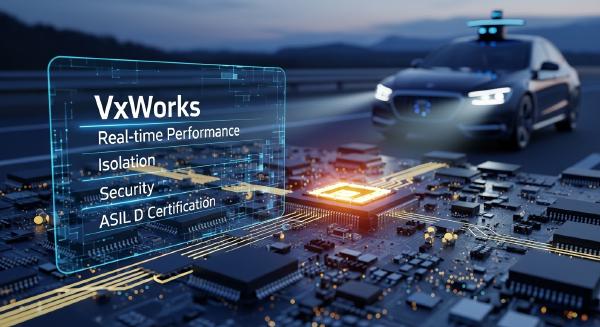
VxWorks combines deterministic real-time performance with modern development frameworks, cloud-native workflows, AI/ML capabilities, and support for contemporary programming languages. The result is a development platform designed to bridge traditional embedded engineering with the workflows expected by modern software teams.
Embedded software development is evolving beyond the traditional model of writing tightly coupled firmware, building locally, and deploying directly to hardware. Modern teams increasingly need reproducible development environments, automated testing, CI/CD, open-source ecosystems, cloud integration, AI/ML capabilities, and support for modern programming languages—without sacrificing the determinism, reliability, and safety required by embedded systems.
VxWorks addresses this convergence by extending the capabilities of a real-time operating system into a broader development ecosystem.
Rather than treating modern software practices as separate from embedded engineering, VxWorks provides pathways for integrating established frameworks, cloud-native workflows, contemporary languages, and edge AI into mission-critical systems.
🧩 Modern Software Frameworks for Embedded Development #
A modern embedded platform needs to integrate with the software ecosystems developers already understand.
VxWorks supports a range of frameworks and interfaces that help teams reuse existing expertise and software components while maintaining the characteristics required for real-time applications.
AUTOSAR for Automotive Systems #
AUTOSAR provides standardized software architecture and interfaces for automotive electronic systems.
VxWorks can support automotive development scenarios where deterministic behavior, modularity, and safety are important requirements. This makes it suitable for applications such as advanced driver-assistance systems (ADAS) and other automotive control systems.
ROS 2 for Robotics #
ROS 2 provides a widely adopted middleware and development ecosystem for robotics.
Combining ROS 2 with VxWorks enables developers to build robotic systems that require both modern robotics middleware and deterministic real-time execution.
Potential applications include autonomous navigation, robotic manipulation, industrial automation, and other systems where perception and control must operate under predictable timing constraints.
OpenCV for Computer Vision #
OpenCV provides a broad collection of computer-vision algorithms and tools.
Its use in embedded environments enables applications such as image processing, object detection, visual inspection, and machine perception while allowing developers to leverage an established open-source ecosystem.
POSIX Compatibility #
POSIX support can simplify application portability by providing standardized operating-system interfaces familiar to developers working across Unix-like environments.
For teams maintaining software across multiple platforms, this can reduce the amount of platform-specific code required and make it easier to transfer existing development knowledge into embedded environments.
☁️ Cloud-Native Development for Embedded Systems #
Embedded development is increasingly becoming part of distributed software engineering organizations.
Development teams may work across multiple locations, maintain large source-code repositories, run automated test infrastructure, and continuously deliver software to multiple hardware targets.
Cloud-native development practices can help address these requirements.
Containers and Orchestration #
Container-based workflows can provide reproducible development and testing environments.
For embedded teams, this can help standardize toolchains, automate build environments, and reduce differences between individual developers’ machines and CI infrastructure.
Container orchestration can also support larger-scale automated testing and build workloads when projects target multiple configurations or architectures.
Cloud-Based Development Environments #
Cloud-based development environments allow distributed teams to share consistent tooling and infrastructure.
This approach can simplify onboarding, improve build reproducibility, and allow development resources to scale independently from individual workstations.
For embedded projects with complex cross-compilation and testing requirements, standardized environments can be particularly valuable.
💻 Modern Programming Languages for Embedded Systems #
Contemporary embedded development is no longer limited to a single programming language.
C and C++ remain fundamental to many real-time systems, but developers increasingly expect access to languages and libraries that provide stronger safety guarantees, faster development cycles, and broader software ecosystems.
Rust for Embedded Systems #
Rust is increasingly relevant to embedded software because of its memory-safety guarantees and low-level performance characteristics.
For applications where memory corruption and concurrency errors represent significant risks, Rust can provide stronger compile-time guarantees than traditional systems-programming approaches.
Its use alongside established embedded codebases also creates opportunities for teams to introduce memory-safe components incrementally rather than rewriting entire systems.
Python for Development and AI/ML #
Python provides a productive environment for prototyping, data processing, machine learning workflows, and system tooling.
In embedded AI development, Python can be particularly useful for preparing data, developing inference pipelines, and integrating machine-learning workflows with edge applications.
Modern C and C++ #
VxWorks also supports established systems-programming technologies, including C11 and C++17.
Modern C++ features can improve abstraction and maintainability without abandoning the performance characteristics expected from embedded systems.
Libraries such as Boost further extend the available C++ ecosystem and allow developers to reuse widely adopted components rather than implementing common functionality from scratch.
🤖 AI and Machine Learning at the Edge #
AI inference is increasingly moving from centralized cloud infrastructure toward devices that can process data locally.
For embedded systems, edge AI can reduce latency, limit bandwidth requirements, and allow devices to make decisions without continuously sending sensitive or high-volume data to remote servers.
VxWorks provides a path for integrating AI/ML workloads into embedded applications.
Python-Based Data and ML Workflows #
Libraries such as NumPy and Pandas provide established tools for numerical computing and data processing.
These ecosystems can support development and experimentation before models or processing pipelines are integrated into production edge applications.
TensorFlow Lite for Edge Inference #
TensorFlow Lite is designed for machine-learning inference on resource-constrained devices.
Its lightweight execution model makes it suitable for applications where inference needs to occur close to the data source rather than in a remote cloud environment.
Potential use cases include:
- Computer vision
- Predictive maintenance
- Industrial inspection
- Robotics perception
- Edge analytics
- Intelligent IoT devices
The combination of real-time execution and local inference can be particularly valuable when AI decisions need to be made within predictable timing constraints.
🏭 Real-World Applications Across Industries #
The value of an embedded platform ultimately depends on how effectively it addresses the constraints of real-world systems.
VxWorks is positioned for applications where reliability, deterministic execution, security, and long-term maintainability are critical.
Aerospace and Defense #
Aerospace and defense systems require predictable behavior under demanding operating conditions.
VxWorks can support avionics and other mission-critical systems where real-time performance, reliability, and compliance with industry safety requirements are fundamental.
Automotive #
Automotive platforms increasingly combine real-time control with connectivity, perception, and increasingly autonomous functionality.
VxWorks can support applications involving AUTOSAR, ADAS, vehicle control, and autonomous-driving architectures, where deterministic behavior and system reliability are essential.
Robotics #
Robotic systems require tight coordination between perception, planning, communication, and motion control.
Combining VxWorks with ROS 2 and OpenCV can provide a foundation for robotics applications involving navigation, visual perception, robotic manipulation, and industrial automation.
Industrial IoT #
Industrial systems can use edge computing and machine learning to analyze equipment data locally.
Applications such as predictive maintenance can process sensor information near the equipment, identify anomalies, and potentially respond before failures result in significant downtime.
🛠️ Developer Productivity and Tooling #
A complete embedded development environment requires more than an operating system and compiler.
Developers also need tools for debugging, simulation, profiling, testing, automation, and deployment.
IDE Integration #
Integration with modern development environments can provide familiar workflows for source-code editing, debugging, project management, and version control.
Eclipse- and VS Code-based environments can help teams maintain development workflows that are closer to those used in mainstream software engineering.
Simulation and Testing #
Simulation allows developers to validate portions of system behavior before deploying software to physical hardware.
This can reduce hardware dependency during early development and enable automated testing at a larger scale.
For complex embedded projects, simulation and virtualized testing can also shorten feedback cycles and help identify software defects earlier.
CI/CD Integration #
Continuous integration and continuous delivery practices allow teams to automate builds, testing, quality checks, and release workflows.
VxWorks-based development can be integrated into CI/CD environments using tools such as Jenkins and GitHub Actions, allowing embedded software to participate in the same automated development pipelines used by enterprise software teams.
Cross-Compilation and Profiling #
Cross-compilation remains fundamental to embedded development because target hardware often differs from the developer’s workstation.
Profiling and performance-analysis tools can help developers identify CPU, memory, scheduling, and application-level bottlenecks across target architectures.
Together, these capabilities help shift embedded development from manual hardware-centric workflows toward more automated engineering processes.
🔐 Reliability, Safety, and Modernization #
One of the biggest challenges in embedded development is modernizing the software stack without compromising the characteristics that made established RTOS platforms attractive in the first place.
Modern frameworks and programming languages can improve developer productivity, but mission-critical systems still require predictable execution, controlled resource usage, security, and rigorous validation.
VxWorks sits at this intersection.
Its value is not simply that it supports modern technologies. The more important capability is integrating those technologies with a real-time foundation suitable for systems where software behavior can directly affect physical processes.
🚀 The Future of Embedded Software Development #
Embedded systems are becoming increasingly autonomous, connected, and intelligent.
Several trends are driving this transformation:
- Edge AI is moving machine-learning inference closer to sensors and physical systems.
- Cloud-native workflows are bringing distributed development and automation into embedded engineering.
- Modern programming languages are introducing stronger safety and productivity features.
- Robotics frameworks are standardizing software interfaces for increasingly complex autonomous systems.
- Industrial IoT is connecting physical equipment with real-time analytics and machine learning.
- Automotive software is becoming increasingly centralized, connected, and software-defined.
These trends require embedded platforms to evolve beyond traditional RTOS functionality.
The future embedded developer needs an environment that combines low-level control with high-level software ecosystems.
🎯 Why VxWorks Matters to the Modern Developer #
The modern embedded developer needs to balance several competing requirements:
- Real-time determinism
- Safety and security
- Developer productivity
- Software portability
- Cloud integration
- AI/ML capabilities
- Open-source ecosystem compatibility
- Automated testing and deployment
- Long-term maintainability
VxWorks addresses these requirements through a combination of RTOS capabilities, modern frameworks, programming-language support, development tooling, cloud-native workflows, and edge AI technologies.
The result is more than a traditional embedded operating system.
It is a development platform intended to connect established real-time engineering practices with the broader software-development ecosystem.
Conclusion #
The modern embedded software landscape is no longer isolated from mainstream software engineering.
Developers building autonomous vehicles, robotics platforms, industrial equipment, aerospace systems, and intelligent edge devices increasingly need the same capabilities expected in cloud and enterprise development: modern languages, automated pipelines, reusable frameworks, scalable tooling, and AI/ML integration.
At the same time, these systems cannot simply abandon the deterministic behavior, reliability, safety, and security requirements that define embedded engineering.
VxWorks occupies this intersection by providing a real-time foundation while enabling developers to adopt modern software-development practices.
For teams building the next generation of embedded, autonomous, connected, and AI-enabled systems, the ability to combine real-time reliability with modern development workflows may be just as important as the operating system itself.