VxWorks in VoIP Gateways: BSP, Drivers, and H.323 Integration
As telecommunications infrastructure evolved from circuit-switched networks toward packet-based IP communications, embedded real-time operating systems became critical to ensuring deterministic voice processing, signaling reliability, and carrier-grade availability.
Among the most influential embedded operating systems in telecom infrastructure was VxWorks, the commercial RTOS developed by Wind River Systems. Known for its deterministic scheduling, modular architecture, and robust networking stack, VxWorks became widely adopted in networking, aerospace, industrial automation, and telecommunications platforms.
This article examines how VxWorks was applied in an Internet Telephone (VoIP) Gateway built around the Intel 80960RD processor, covering:
- Real-time operating system architecture
- Tornado development workflow
- Board Support Package (BSP) implementation
- Device driver development
- H.323 protocol stack integration
- Real-time optimization strategies
It also explores how these architectural principles continue influencing modern carrier-grade VoIP and edge communication systems.
📡 Internet Telephone Gateway Architecture #
An Internet Telephone Gateway bridges traditional PSTN infrastructure with IP-based communication networks.
Core responsibilities include:
- Voice encoding and decoding
- RTP packetization
- Echo cancellation
- Call signaling
- Media stream management
- Real-time transport handling
Typical Hardware Composition #
The gateway platform described in this implementation included:
| Component | Function |
|---|---|
| Intel 80960RD CPU | Main control processor |
| DSP Subboard | Voice codec processing and echo cancellation |
| Switching Chip | Voice timeslot switching |
| Ethernet Interface | IP connectivity |
| E1/T1 Interfaces | PSTN integration |
| Serial Port | Debug and maintenance |
The system required strict real-time guarantees for voice latency, making VxWorks a strong fit for the platform.
⚙️ Why VxWorks Was Selected #
VxWorks offered several advantages particularly valuable in telecom systems:
- Deterministic real-time scheduling
- Extremely low interrupt latency
- Small memory footprint
- Modular architecture
- Mature networking stack
- Reliable inter-task communication primitives
- Strong hardware portability via BSPs
In VoIP gateways, latency consistency matters more than raw throughput. Packet jitter, scheduling delays, and interrupt unpredictability directly impact voice quality.
VxWorks was specifically engineered for these constraints.
🧠 VxWorks RTOS Architecture #
Wind Kernel #
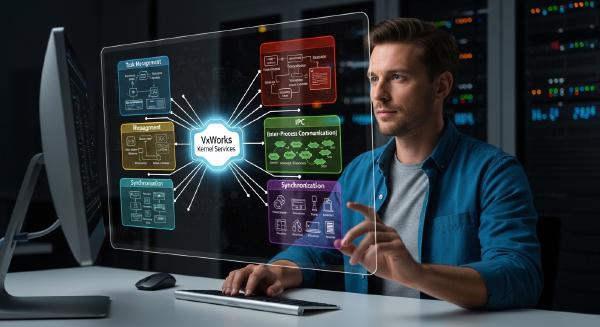
The core of VxWorks is the Wind Kernel, which provides:
- Priority-based preemptive scheduling
- 256 task priority levels
- Round-robin scheduling support
- Fast context switching
- Microsecond-scale interrupt handling
Inter-Task Synchronization #
Synchronization primitives include:
| Mechanism | Purpose |
|---|---|
| Binary semaphores | Event signaling |
| Counting semaphores | Resource counting |
| Mutex semaphores | Mutual exclusion with priority inheritance |
Priority inheritance was particularly important in preventing priority inversion during high-priority RTP processing.
IPC Mechanisms #
VxWorks supported several lightweight IPC models:
- Message queues
- Pipes
- Signals
- BSD sockets
These mechanisms enabled modular separation between signaling, media processing, and hardware control tasks.
🛠️ Tornado Development Environment #
The project used the Tornado IDE and cross-development environment from Wind River.
Tornado provided:
- Cross-compilation tools
- Remote debugging
- Real-time tracing
- System introspection
- Target management
Major Tornado Components #
| Tool | Function |
|---|---|
| CrossWind | Source-level debugger |
| WindSh | Interactive shell |
| WindView | Real-time performance analyzer |
| Browser | Object inspection |
| StethoScope | System monitoring |
Debugging Modes #
Tornado supported two debugging approaches:
| Mode | Description |
|---|---|
| System Mode | Full system halt debugging |
| Task Mode | Dynamic task-level debugging |
Task-mode debugging was especially useful for observing live voice-processing tasks without stopping the entire system.
🧩 Board Support Package (BSP) Design #
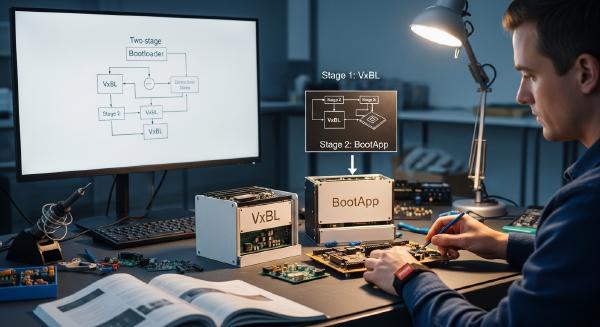
The BSP layer adapts VxWorks to custom hardware.
For the Intel 80960RD platform, the BSP included critical initialization logic for:
- CPU startup
- Interrupt configuration
- Clock systems
- PCI interfaces
- Memory mapping
- Peripheral initialization
Key BSP Files #
| File | Purpose |
|---|---|
romInit.s |
Assembly startup code |
sysLib.c |
Hardware abstraction layer |
usrConfig.c |
Kernel and application configuration |
BSP Initialization Sequence #
romInit:
    /* Disable interrupts */
    /* Hardware low-level initialization */
    /* Jump to romStart */
void romStart(void) {
/* Copy sections into RAM */
userInit();
}void userInit(void) {
sysHwInit();
kernelInit();
}void userRoot(void) {
/* Install drivers */
/* Initialize networking */
/* Start application tasks */
}This staged startup model ensured deterministic initialization and reliable subsystem ordering.
🔌 Hardware Initialization and System Clocks #
The BSP initialized low-level hardware resources before kernel scheduling began.
Example:
void sysHwInit(void) {
    sysClkInit(1000);      /* 1ms system tick */
    sysAuxClkInit(100);

    pciConfigOutLong(
        PCI_BUS,
        PCI_DEV,
        PCI_FUNC,
        PCI_COMMAND,
        0x00000006
    );

    sysBusToLocalAdrs(...);
}
Key Responsibilities #
The initialization layer handled:
- Timer setup
- Interrupt controller configuration
- PCI bridge initialization
- Shared memory mapping
- DSP communication interfaces
Accurate timer configuration was especially critical for RTP packet timing and jitter control.
🧱 Device Driver Architecture #
VxWorks device drivers integrated through the RTOS I/O subsystem.
Example Driver Registration #
STATUS pciDrvInstall(void) {
    return iosDrvInstall(
        pciOpen,
        pciClose,
        pciRead,
        pciWrite,
        pciIoctl,
        NULL,
        NULL
    );
}
Interrupt Handling Workflow #
Interrupt service routines remained intentionally lightweight:
void pciIsr(void) {
    if (pciInterruptPending()) {
        pciClearInterrupt();
        semGive(intSem);
    }
}
Actual processing occurred inside dedicated handler tasks:
void pciIntHandler(void) {
    while (1) {
        semTake(intSem, WAIT_FOREVER);

        processDspData();
        handleSwitchingEvents();
    }
}
This separation minimized ISR latency while maintaining deterministic scheduling behavior.
🌐 Ethernet and Networking Integration #
The Ethernet subsystem integrated with the VxWorks MUX networking layer.
This enabled:
- TCP/IP communication
- RTP media transport
- H.323 signaling
- Remote management services
VxWorks provided a BSD-compatible socket API, simplifying integration with networking middleware.
RTP Socket Example #
SOCKET s = socket(AF_INET, SOCK_DGRAM, 0);

bind(s, ...);

sendto(s, rtpPacket, len, 0, ...);
The lightweight networking stack was critical for sustaining real-time voice traffic under constrained hardware conditions.
☎️ H.323 Protocol Stack Integration #
The gateway utilized a third-party H.323 protocol stack running atop VxWorks.
Responsibilities of the H.323 Stack #
The stack handled:
- Call establishment
- Capability negotiation
- Media session setup
- RTP coordination
- Signaling state management
Lower-Layer Integration Modules #
The stack interfaced with VxWorks through several abstraction layers:
| Module | Function |
|---|---|
| LAN Interface | Socket communication |
| Timer Module | Watchdog and timing services |
| Message Module | Queue-based IPC |
| Memory Module | Custom memory pools |
| PDLRAW | Protocol description handling |
Timer Services #
Timing services leveraged native VxWorks APIs:
wdCreate();
wdStart();
taskDelay();
Deterministic timer handling was essential for retransmissions, session management, and RTP scheduling.
🎛️ Task Scheduling Strategy #
Voice workloads were prioritized aggressively.
Typical task priority allocation:
| Task Type | Priority |
|---|---|
| RTP Voice Processing | Highest |
| H.225/H.245 Signaling | Medium |
| Management Tasks | Lower |
This ensured that real-time media handling remained unaffected by background management operations.
Real-Time Optimization Techniques #
Several optimization techniques improved system stability:
- Priority inheritance semaphores
- DMA transfers between CPU and DSP
- Reduced ISR complexity
- WindView performance profiling
- Dedicated RTP processing tasks
The design target maintained:
- Sub-10 ms voice packet processing latency
This was critical for maintaining acceptable conversational voice quality.
🚀 Modern Perspective: VxWorks in 2026 #
Although H.323 has largely been replaced by SIP and WebRTC, the underlying real-time principles remain highly relevant.
Modern carrier-grade communication systems still rely on:
- Deterministic scheduling
- Priority-aware processing
- Efficient IPC
- Low-latency networking
- Hardware abstraction layers
Modern VxWorks Deployments #
Contemporary systems increasingly utilize:
- VxWorks 7
- Wind River Helix
- Multi-core ARM and x86 SoCs
- TSN networking
- Secure RTP (SRTP)
- Zero-trust security architectures
- OTA update frameworks
- Containerized media services
Evolution of Telecom Infrastructure #
Today’s VoIP gateways and Session Border Controllers commonly support:
- SIP
- WebRTC
- Cloud-native orchestration
- NFV architectures
- AI-assisted traffic management
However, the core engineering disciplines established in early VxWorks telecom systems continue to influence modern embedded networking design.
📌 Conclusion #
VxWorks demonstrated exceptional suitability for real-time VoIP gateway systems built on the Intel 80960RD platform.
Its deterministic scheduler, modular BSP architecture, robust networking stack, and mature IPC mechanisms enabled reliable integration of:
- DSP-based media processing
- H.323 signaling
- RTP transport
- Hardware switching systems
- Real-time communication workloads
The project highlighted how carefully engineered RTOS architecture can deliver carrier-grade reliability even on resource-constrained embedded hardware.
While telecom infrastructure has evolved significantly since the early H.323 era, the foundational concepts pioneered in these systems remain central to modern real-time communication platforms.
Reference: VxWorks in VoIP Gateways: BSP, Drivers, and H.323 Integration