How VxWorks Powered NASA’s Artemis II Crewed Lunar Mission
NASA’s Artemis II marked the first crewed lunar mission in over five decades, successfully sending four astronauts around the Moon and back. Behind this milestone was a robust software foundation—Aptiv’s VxWorks real-time operating system (RTOS)—enabling deterministic execution, system reliability, and mission-critical safety across multiple subsystems.
🚀 Role of VxWorks in Artemis II #
VxWorks served as a core software platform for critical operations in both the Space Launch System (SLS) and the Orion crew vehicle. Its deterministic scheduling and real-time guarantees ensured predictable behavior under strict timing constraints—essential for aerospace systems where failure is not an option.
The RTOS powered key functions including:
- First-stage launch operations of the SLS
- Flight and control systems within Orion
- Core elements of NASA’s flight system architecture
VxWorks has an extensive legacy in aerospace, having supported missions ranging from Mars rovers to the James Webb Space Telescope. Its continued use in Artemis reinforces its position as a de facto standard for mission-critical embedded systems.
🛰️ Mission Overview and Validation Objectives #
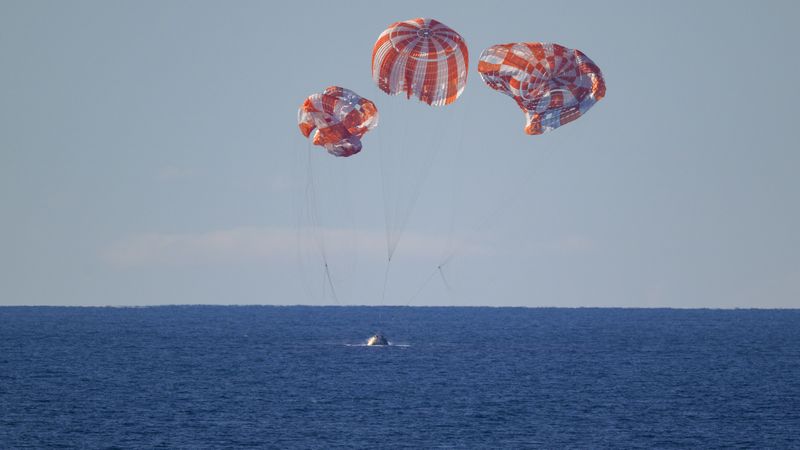
The Artemis II mission spanned 10 days, during which the Orion spacecraft traveled beyond low Earth orbit, orbited the Moon, and returned safely. The mission focused on validating:
- Deep-space system performance
- Life support systems for extended missions
- Crew operational readiness for future missions such as Artemis III
This mission served as a full-scale integration test under real deep-space conditions, providing high-confidence validation for future lunar exploration.
🛡️ Fault Tolerance and Safety Architecture #
Backup Flight System (BFS) #
A key component of mission safety was the Orion Backup Flight System (BFS). Designed as a fully independent and Class A certified system, the BFS operates with:
- No shared components with the primary system
- No common failure modes
- Distinct architectural design to ensure redundancy
This level of isolation significantly reduces systemic risk and ensures continued operation in the event of primary system failure.
Deterministic Real-Time Guarantees #
VxWorks enables strict timing guarantees through:
- Priority-based preemptive scheduling
- Low-latency interrupt handling
- Memory protection and partitioning
These features are essential for maintaining system stability across critical mission phases such as launch, orbital maneuvers, and re-entry.
🧪 Digital Twin Simulation and Validation #
Aptiv employed a digital twin simulation strategy to validate all flight software prior to deployment. This approach allowed engineers to:
- Execute unmodified target software in a virtual environment
- Simulate real hardware behavior with high fidelity
- Decouple software development from hardware constraints
A key advantage of this methodology is reusability—up to 80–90% of simulation models can be reused across future missions, significantly reducing development time and cost.
🧩 Software as a Mission-Critical Enabler #
Artemis II highlights the central role of software in modern aerospace systems. VxWorks functioned as a foundational layer enabling:
- Reliable communication between subsystems
- Safe execution of life-critical operations
- Consistent performance under extreme conditions
This level of reliability is the result of decades of engineering investment in safety-certified, high-assurance RTOS platforms.
📌 Conclusion #
The success of Artemis II underscores the importance of deterministic, mission-critical software in human spaceflight. VxWorks not only enabled real-time system performance across multiple spacecraft components but also contributed directly to crew safety and mission success.
As NASA advances toward more complex missions such as Artemis III and beyond, the role of proven RTOS platforms and scalable validation strategies like digital twins will only become more critical in ensuring reliability in deep space exploration.
Reference: How VxWorks Powered NASA’s Artemis II Crewed Lunar Mission