NASA HPSC: The Space Processor Powering Autonomous Exploration
Spacecraft computing has traditionally been defined by a difficult compromise: survive first, perform second.
Radiation, extreme temperatures, vibration, limited power budgets, and missions lasting years or decades make conventional commercial processors unsuitable for many space applications. Radiation can corrupt memory and calculations, while hardware failures can be effectively impossible to repair once a spacecraft leaves Earth.
That model is beginning to change.
In May 2026, NASA announced testing of its next-generation space processor at the Jet Propulsion Laboratory (JPL) in Southern California. The processor is part of NASA’s High Performance Spaceflight Computing (HPSC) initiative, a program designed to dramatically increase spacecraft computing capability while maintaining the reliability required for spaceflight.
Developed with Microchip Technology, the HPSC platform combines multi-core 64-bit processing, radiation protection, fault tolerance, high-speed networking, security, and AI-oriented computing capabilities.
NASA expects HPSC to provide more than a hundredfold improvement in performance per watt compared with current space-qualified computing systems.
That improvement is important because spacecraft power is one of their most constrained resources. Every watt saved by the computing subsystem can potentially be redirected toward scientific instruments, communications, propulsion, sensors, or other mission-critical systems.
More importantly, HPSC is not simply a faster processor. It provides the computational foundation for a different class of spacecraft—systems capable of analyzing their environments, making decisions locally, and operating with substantially less dependence on Earth.
🚀 Why Spacecraft Need a New Computing Architecture #
Space is an exceptionally hostile environment for electronics.
Energetic particles from the Sun and cosmic rays can cause single-event upsets, corrupt memory, alter processor state, or permanently damage semiconductor structures. Extreme temperatures, mechanical stress, and long mission lifetimes add further constraints.
Traditional space-qualified processors therefore prioritize reliability and radiation tolerance, often at the expense of raw performance.
That trade-off worked well for many previous generations of spacecraft. However, modern exploration missions are producing increasingly complex workloads.
Advanced instruments generate larger datasets. Autonomous navigation requires continuous sensor processing. AI-based science applications require substantial compute resources. Deep-space missions also need to make decisions without waiting for instructions from Earth.
HPSC is intended to address these requirements by bringing significantly greater computational capability to the spacecraft itself.
🧠 What Is NASA’s HPSC? #
The High Performance Spaceflight Computing architecture is a 64-bit, multi-core system-on-chip designed specifically for spaceflight applications.
Its architecture combines several capabilities that are traditionally implemented across separate spacecraft subsystems:
- Cache-coherent multi-core processing
- Radiation-hardened and radiation-tolerant implementations
- Fault-tolerant computing
- High-speed networking
- AI and machine-learning acceleration support
- Virtualization
- PCIe connectivity
- Compute Express Link (CXL)
- Ethernet and Time-Sensitive Networking (TSN)
- Cryptographic and security capabilities
- Dynamic power-management features
The HPSC family is designed to support different levels of radiation protection depending on mission requirements. Processing functions that are not required at a particular moment can also be disabled or placed into lower-power states.
HPSC becomes both a processor and networking platform #
One of the architecture’s notable features is its integrated 240 Gb/s TSN Ethernet switch.
This allows large amounts of data to move between sensors, scientific instruments, storage, and compute resources without requiring the spacecraft to rely entirely on separate networking hardware.
The result is more than a conventional CPU upgrade. HPSC can serve as a central computing and data-movement platform for future spacecraft architectures.
That integration is particularly valuable for systems containing multiple high-bandwidth sensors and instruments whose data must be processed in real time.
🌌 Communication Delays Make Onboard Computing Essential #
As spacecraft travel farther from Earth, communication latency becomes one of the fundamental constraints on mission operations.
A radio signal takes roughly 1.3 seconds to travel between Earth and the Moon, while communication with Mars can require approximately 4 to 24 minutes each way, depending on the relative positions of the planets.
Jupiter missions face even greater delays.
These latencies make conventional Earth-controlled operations impractical for time-critical events.
During landing, autonomous navigation, collision avoidance, or rapidly changing scientific observations, waiting several minutes for an instruction from Earth could mean that the relevant event has already passed.
HPSC enables more computation to occur directly on the spacecraft.
Instead of continuously asking mission control what to do, an autonomous spacecraft can process sensor information locally, evaluate possible actions, and respond immediately.
Local decision-making changes mission architecture #
This represents a fundamental shift in spacecraft design.
Traditional spacecraft can be thought of as remote systems whose primary intelligence remains on Earth. More capable onboard computing allows the spacecraft itself to become an active decision-making component.
A future autonomous system could:
- Collect data from multiple sensors.
- Process and correlate the information locally.
- Detect important events or hazards.
- Select an appropriate response.
- Execute the response without waiting for Earth.
- Transmit the resulting information when communications are available.
That workflow reduces dependence on continuous communication and makes missions more resilient to long-distance latency.
🤖 HPSC Brings AI and Edge Computing Into Space #
Artificial intelligence is particularly well suited to the problems created by communication latency and limited bandwidth.
Machine-learning models can process large quantities of sensor and imaging data directly on the spacecraft, allowing the system to identify useful information before transmission.
An HPSC-based spacecraft could potentially use AI for applications such as:
- Geological feature detection
- Terrain classification
- Hazard identification
- Autonomous navigation
- Landing-site assessment
- Scientific image analysis
- Sample-site prioritization
- Sensor-data classification
- Mission-planning assistance
Rather than transmitting every observation to Earth, the spacecraft could determine which data deserves immediate attention.
Autonomous landing and navigation #
Landing is one of the clearest examples of why onboard computing matters.
A spacecraft approaching the surface must process information from cameras, lidar, radar, inertial sensors, and other systems while operating under strict timing constraints.
An onboard compute platform can analyze these data streams simultaneously and support terrain-relative navigation and autonomous hazard avoidance.
This allows the spacecraft to react to dangerous terrain or unexpected conditions much faster than an architecture that depends on instructions from Earth.
📡 Solving the Space Data Explosion #
The growth of scientific instrumentation is creating another major challenge: spacecraft can generate more data than they can practically transmit.
The Deep Space Network and other communications infrastructure have finite bandwidth. As instruments become more capable, simply sending every raw observation back to Earth becomes increasingly inefficient.
Powerful onboard computing changes the economics of that data pipeline.
Instead of treating the spacecraft as a passive data collection device, the system can perform intelligent preprocessing before transmission.
For example, onboard software could:
- Filter redundant observations
- Compress scientific datasets
- Identify unusual features
- Prioritize high-value images
- Detect transient events
- Combine information from multiple sensors
- Discard low-value data
The spacecraft effectively becomes an intelligent edge-computing node.
Computing at the edge increases scientific return #
This approach can increase the amount of useful science generated per unit of communications bandwidth.
A Mars rover, for example, could identify scientifically interesting geological formations locally and prioritize those observations rather than transmitting every image with equal priority.
A space telescope could analyze observations before sending them to Earth.
A deep-space probe could detect an unexpected event and immediately adjust its observation strategy.
The farther a spacecraft travels from Earth, the more valuable this capability becomes.
🛰️ HPSC as a Platform for Next-Generation Missions #
The significance of HPSC ultimately extends beyond processor specifications.
Its combination of computing performance, networking, fault tolerance, and AI capabilities creates a foundation for new spacecraft architectures.
Potential applications include:
- Deep-space probes: Autonomous adjustment of scientific observations and mission operations.
- Mars rovers: More independent navigation and terrain analysis.
- Space telescopes: Local processing and prioritization of astronomical observations.
- Lunar vehicles: Reduced dependence on continuous Earth supervision.
- Distributed spacecraft: High-speed coordination between multiple autonomous vehicles.
- Scientific platforms: Real-time analysis of instrument data before transmission.
The common theme is autonomy.
Future spacecraft may increasingly operate less like remotely controlled machines and more like distributed intelligent systems capable of sensing, analyzing, prioritizing, and responding to their environments.
🧩 HPSC Requires a Software Ecosystem #
Advanced hardware alone cannot deliver autonomous spacecraft.
HPSC needs a software stack capable of taking advantage of multi-core processing, virtualization, AI acceleration, high-speed networking, and strict mission-assurance requirements.
The ecosystem is designed around widely used technologies and development environments. Developers can work with platforms such as Debian and Yocto Linux, along with toolchains and frameworks including LLVM, Python, OpenCL, OpenMP, and TensorFlow Lite.
This approach can reduce the software barrier for developers coming from terrestrial high-performance and embedded computing environments.
For missions with stringent certification, long-term maintenance, and reliability requirements, commercially supported operating systems and virtualization platforms can provide additional assurance.
Why real-time operating systems matter #
Spacecraft software often combines workloads with radically different requirements.
A navigation system may require deterministic real-time execution. A machine-learning application may require high computational throughput. Scientific processing may prioritize raw data bandwidth.
Running everything within a single undifferentiated software environment can make isolation and certification more difficult.
A virtualization architecture can instead divide the processor into isolated execution environments.
For example, a future spacecraft could run:
- A safety-critical navigation system in one partition
- An AI-based terrain-classification workload in another
- Scientific instrument processing in a third
This separation allows different workloads to coexist while reducing the risk that a failure in one software component compromises the entire system.
Wind River’s role in the HPSC ecosystem #
Wind River has extensive experience with embedded, aerospace, and defense systems where deterministic execution, reliability, and long-term software support are critical.
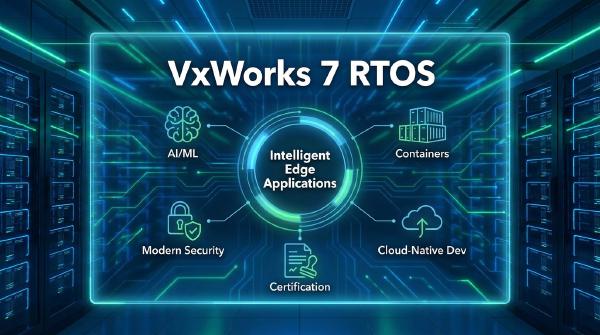
Its VxWorks real-time operating system, eLxr Linux distribution, and Helix Virtualization Platform provide software options for architectures that need to combine real-time processing, Linux workloads, and isolated applications on the same hardware.
For HPSC-class systems, virtualization can become particularly important because spacecraft developers increasingly need to integrate traditional safety-critical workloads with newer AI and high-performance computing applications.
The ability to isolate those workloads on a common multi-core platform can reduce hardware duplication while maintaining architectural separation between mission-critical functions.
🔭 HPSC Could Redefine Spacecraft Computing #
HPSC combines several capabilities that historically required substantial compromises: radiation tolerance, multi-core performance, fault tolerance, high-speed networking, AI readiness, and power efficiency.
Its importance therefore extends beyond the performance of a single processor.
The larger objective is to move more intelligence onto the spacecraft itself.
As missions travel farther from Earth, communication delays increase. As scientific instruments become more capable, data volumes grow. As autonomous operations become more important, spacecraft need increasingly sophisticated local decision-making.
HPSC addresses all three trends simultaneously.
The result could be a new generation of spacecraft capable of processing information in real time, adapting to changing conditions, prioritizing scientific discoveries, and continuing operations even when communication with Earth is delayed or temporarily unavailable.
For the future of deep-space exploration, that may be more important than simply making spacecraft faster. The real breakthrough is giving them enough computing power to understand their environment and act on that information independently.