VxWorks RTOS Architecture and Embedded System Implementation Guide
As embedded systems evolved from simple microcontroller-based designs into complex communication and industrial computing platforms, the demand for deterministic real-time operating systems increased dramatically.
Modern embedded applications require:
- Predictable scheduling
- Low interrupt latency
- Efficient multitasking
- Reliable inter-process communication
- Modular hardware abstraction
- Scalable networking support
Among commercial real-time operating systems, VxWorks became one of the most widely adopted solutions across telecommunications, aerospace, industrial automation, military systems, and networking infrastructure.
This article explores the architecture, scheduling mechanisms, communication models, and engineering implementation workflow of VxWorks, including:
- Wind Kernel architecture
- Task scheduling mechanisms
- Inter-task communication
- BSP development
- BootROM image generation
- Tornado development workflow
- Embedded deployment strategies
⚙️ Overview of VxWorks #
VxWorks is a high-performance embedded real-time operating system developed by Wind River Systems.
It gained widespread adoption because of its:
- Deterministic kernel behavior
- Extremely low interrupt latency
- High reliability
- Small memory footprint
- Scalable modular architecture
- Mature development ecosystem
VxWorks was especially popular in communication systems where real-time responsiveness and system stability were critical.
🧠 Wind Kernel Architecture #
At the core of VxWorks is the Wind Kernel, a lightweight real-time kernel optimized for deterministic multitasking.
Core Kernel Features #
The Wind Kernel provides:
| Feature | Description |
|---|---|
| Preemptive scheduling | Immediate response to high-priority tasks |
| Fast context switching | Minimal scheduling overhead |
| Low interrupt latency | Rapid ISR handling |
| Efficient multitasking | Scalable concurrent execution |
| High networking throughput | Optimized protocol stack interaction |
The kernel was specifically designed for environments where response predictability matters more than general-purpose throughput.
🔄 Task Scheduling Mechanism #
VxWorks uses a priority-driven multitasking model.
Scheduling Policies #
The RTOS supports two primary scheduling mechanisms:
| Scheduling Type | Purpose |
|---|---|
| Priority-based preemptive scheduling | Primary scheduler |
| Round-robin time slicing | Equal-priority fairness |
Priority Levels #
VxWorks supports:
- 256 priority levels
0= highest priority255= lowest priority
Whenever a higher-priority task becomes ready, the kernel immediately preempts the currently running lower-priority task.
This deterministic behavior is one of the defining characteristics of VxWorks.
🧩 Task Context and Task Control Blocks #
Every executing program in VxWorks is represented as a task.
Each task maintains its execution state within a:
- Task Control Block (TCB)
Information Stored in the TCB #
The TCB contains:
| Context Information | Purpose |
|---|---|
| Program counter | Current execution position |
| CPU registers | Execution state |
| Floating-point registers | Numeric processing state |
| Stack information | Function calls and variables |
| Delay parameters | Sleep and timeout handling |
| Signal information | Event handling |
| Debug information | Runtime analysis |
This architecture allows extremely fast task switching while maintaining task isolation.
🚦 Task States in VxWorks #
Tasks transition between multiple execution states during runtime.
Major Task States #
| State | Description |
|---|---|
| READY | Waiting for CPU execution |
| PEND | Waiting for resources |
| DELAY | Sleeping for a specified duration |
| SUSPEND | Suspended manually or by debugger |
Example Transition #
taskActivate();This system call transitions a task from:
SUSPEND → READYThe scheduler then determines when the task receives CPU time.
⚡ Interrupt Handling Design #
Interrupt responsiveness is one of VxWorks’ strongest features.
Dedicated Interrupt Stack #
VxWorks separates:
- Interrupt stack
- Task stack
This reduces task-switch overhead during interrupt handling.
ISR Optimization Strategy #
When an interrupt occurs:
- Only critical registers are saved
- ISR performs minimal work
- Deferred processing is delegated to tasks
This approach minimizes latency while preserving deterministic scheduling behavior.
Deferred Processing Model #
Typical ISR workflow:
ISR → Signal semaphore/message → Worker task processes dataThis design remains common in modern RTOS architectures.
🔗 Inter-Task Communication Mechanisms #
Efficient communication between tasks is critical in real-time systems.
VxWorks provides several IPC mechanisms optimized for different workloads.
🧵 Shared Memory #
Shared memory is the simplest communication model.
Advantages #
- Extremely fast
- Minimal overhead
- Efficient for bulk data exchange
Challenges #
- Requires synchronization
- Risk of race conditions
Shared memory is often paired with semaphores for protection.
🔒 Semaphores #
Semaphores are widely used for:
- Synchronization
- Mutual exclusion
- ISR-to-task signaling
Binary Semaphore Example #
SEM_ID semId;

semId = semBCreate(SEM_Q_PRIORITY,
                   SEM_EMPTY);
ISR Signaling #
semGive(semId);Task Synchronization #
semTake(semId, WAIT_FOREVER);Semaphores are among the fastest synchronization primitives in VxWorks.
📬 Message Queues #
Message queues are the preferred mechanism for structured task communication.
Queue Creation #
MSG_Q_ID msgQId;

msgQId = msgQCreate(
    32,
    128,
    MSG_Q_PRIORITY
);
Sending Messages #
msgQSend(...);Receiving Messages #
msgQReceive(...);Queue Ordering Modes #
| Mode | Behavior |
|---|---|
| FIFO | First-in, first-out |
| PRIORITY | Priority-sorted messages |
Message queues support:
- Task-to-task communication
- ISR-to-task communication
- Timeout handling
🛠️ Tornado Development Environment #
VxWorks development traditionally relied on the Tornado integrated development environment.
Tornado Capabilities #
The IDE provided:
- Cross-compilation tools
- Remote debugging
- Kernel configuration
- Symbol inspection
- Target management
- Runtime analysis
Supported Host Platforms #
Tornado could run on:
- Windows NT
- Unix
- Linux workstations
🧩 Board Support Package (BSP) Development #
The BSP adapts VxWorks to a specific hardware platform.
Responsibilities of the BSP #
The BSP handles:
- CPU initialization
- Memory setup
- Interrupt configuration
- Cache control
- Device initialization
- Bootloader integration
Without a BSP, VxWorks cannot interact with the target hardware.
📁 Key BSP Files #
Several files form the core of a VxWorks BSP.
| File | Purpose |
|---|---|
Makefile |
Build configuration |
romInit.s |
Low-level assembly startup |
config.h |
Kernel configuration macros |
bootConfig.c |
Boot hardware initialization |
bootInit.c |
FLASH-to-RAM image copying |
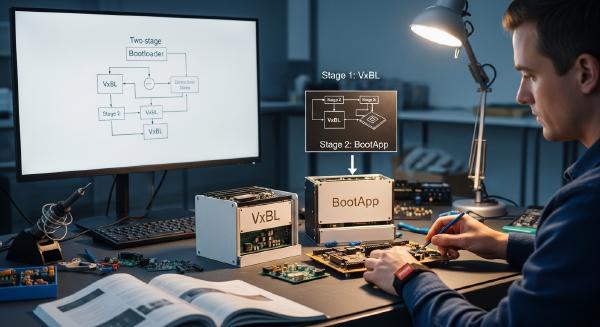
🚀 Boot Initialization Process #
The boot sequence typically follows this order:
Power On
    ↓
romInit.s
    ↓
bootInit.c
    ↓
bootConfig.c
    ↓
VxWorks Kernel Startup
Responsibilities of romInit.s
#
The assembly startup code typically:
- Disables interrupts
- Initializes CPU registers
- Disables cache temporarily
- Configures memory
- Prepares execution environment
Because assembly debugging is difficult during early boot, developers often use:
- LEDs
- GPIO toggles
- Serial output
for low-level debugging visibility.
💾 VxWorks Image Types #
VxWorks supports several image formats optimized for different deployment scenarios.
| Image Type | Execution Method | Typical Usage |
|---|---|---|
VxWorks |
Downloaded into RAM | Debugging |
VxWorks-rom |
Copied from FLASH to RAM | Production systems |
VxWorks-romRes |
Executes directly from ROM | Memory-constrained devices |
🔍 Development and Debugging Workflow #
A common engineering workflow follows these stages:
Stage 1: RAM-Based Debugging #
Developers initially use:
- Ethernet
- RS232 serial connection
to download RAM-based images.
Advantages include:
- Fast iteration
- Breakpoint support
- Runtime inspection
Stage 2: System Validation #
Using Tornado tools, developers can:
- Monitor tasks
- Inspect memory
- Analyze scheduling
- Set breakpoints
- Trace execution flow
Stage 3: Production Deployment #
After validation:
- Build
VxWorks-rom - Burn image into FLASH
- Boot directly from onboard storage
Programming tools commonly included:
- BDM interfaces
- visionClick
- FLASH utilities
📡 POSIX and ANSI C Compliance #
VxWorks was among the earliest RTOS platforms supporting:
- POSIX 1003.1b
- ANSI C compatibility
This improved:
- Software portability
- API consistency
- Third-party integration
Standards compliance helped accelerate adoption in commercial and defense applications.
🚀 Real-Time Advantages of VxWorks #
Several characteristics made VxWorks particularly suitable for mission-critical embedded systems.
Deterministic Scheduling #
High-priority tasks receive immediate CPU access.
Low Interrupt Latency #
Minimal ISR overhead improves responsiveness.
Modular Architecture #
Components can be selectively included or removed.
Efficient IPC #
Fast semaphores and queues reduce synchronization overhead.
Strong Scalability #
The same RTOS architecture could scale from small controllers to complex communication platforms.
🌍 Modern Perspective on VxWorks #
Although modern embedded systems increasingly incorporate Linux-based solutions, VxWorks remains widely used in:
- Aerospace
- Defense systems
- Industrial control
- Avionics
- Satellite systems
- High-reliability networking equipment
Contemporary versions such as:
- VxWorks 7
- Wind River Helix
introduce:
- Multi-core scheduling
- Security hardening
- Container support
- TSN networking
- Advanced tracing tools
- OTA update systems
However, the foundational concepts explored in classic VxWorks systems remain central to real-time operating system design today.
📌 Conclusion #
VxWorks established itself as one of the most influential embedded real-time operating systems because of its deterministic scheduling, efficient interrupt handling, modular architecture, and mature development ecosystem.
Its engineering workflow — including BSP development, BootROM generation, and Tornado-based debugging — provided developers with a complete framework for building reliable embedded systems across a wide range of industries.
The principles discussed in this article remain highly relevant for modern embedded engineering, especially in systems where predictability, low latency, and reliability are non-negotiable requirements.