The Continuous Edge AI Lifecycle: Why Intelligence Belongs Beyond the Cloud
For more than a decade, enterprise IT strategies have centered on consolidating workloads into hyperscale cloud infrastructure. Compute, storage, and applications migrated away from physical hardware toward virtualized and containerized environments, enabling unprecedented scalability and operational efficiency.
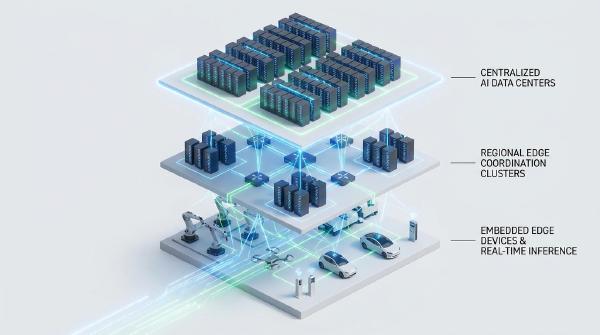
Today, however, artificial intelligence is driving the next major architectural evolution. Rather than centralizing every workload, organizations are increasingly moving intelligence closer to where data is generated and decisions must be made. This shift has given rise to Edge AI—a computing model where AI inference executes directly on distributed devices while cloud infrastructure continues to provide centralized training, orchestration, and lifecycle management.
Edge AI is not simply machine learning deployed on embedded hardware. It represents a continuous intelligence loop that connects edge devices, cloud infrastructure, and enterprise operations into a unified system capable of learning, adapting, and improving throughout its operational lifetime.
☁️ Why Intelligence Cannot Live Only in the Cloud #
Cloud computing transformed enterprise software by delivering elastic infrastructure, programmable services, and accelerated development cycles. While these advantages remain indispensable for large-scale AI training, they are insufficient for many real-world applications where decisions must occur within milliseconds.
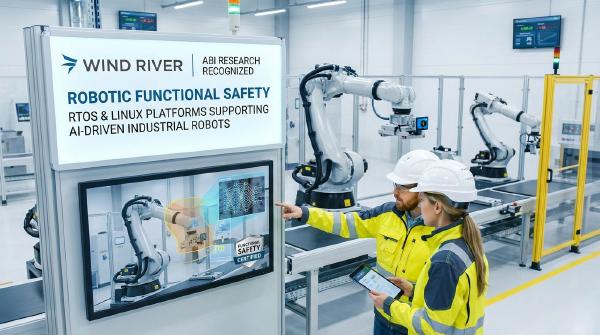
Industries including robotics, automotive, aerospace, industrial automation, telecommunications, and critical infrastructure require deterministic execution that centralized cloud platforms alone cannot provide.
Three primary factors are driving the adoption of Edge AI.
Latency-Sensitive Decision Making #
Many physical systems cannot afford the delays introduced by transmitting sensor data to remote data centers before executing a response.
Applications such as autonomous driving, robotic motion control, machine automation, and energy distribution require local inference capable of making decisions in real time. While cloud environments remain ideal for training sophisticated AI models, execution must occur where actions happen.
Operational Resilience #
Mission-critical systems frequently operate under unreliable, intermittent, or intentionally isolated network conditions.
Manufacturing facilities, aircraft, offshore installations, defense platforms, and remote industrial sites cannot depend on constant cloud connectivity. Edge AI enables these systems to continue operating autonomously while synchronizing with centralized infrastructure whenever connectivity becomes available.
Cost Efficiency #
Streaming raw telemetry from thousands—or even millions—of connected devices quickly becomes prohibitively expensive.
By processing sensor data locally, organizations significantly reduce:
- Network bandwidth consumption
- Cloud storage requirements
- Continuous compute costs
- Data transfer expenses
Instead of transmitting every data point, edge systems forward only actionable information, anomalies, and operational insights.
The future of enterprise AI is therefore not a choice between cloud or edge. It is a coordinated architecture where each environment performs the tasks for which it is best suited.
🔄 Understanding the Continuous Edge AI Lifecycle #
Traditional software deployments followed a straightforward pattern: build, deploy, maintain, and eventually replace. AI-powered systems require a fundamentally different operating model because intelligence must continuously evolve.
Edge AI establishes a closed-loop lifecycle where learning never stops.
Data Collection at the Edge #
The lifecycle begins where data naturally originates.
Connected devices—including industrial machines, autonomous vehicles, robotics platforms, sensors, and intelligent infrastructure—continuously observe the physical world.
Rather than functioning solely as execution platforms, these systems become valuable producers of operational intelligence by capturing:
- Environmental conditions
- Equipment behavior
- Usage patterns
- Performance anomalies
- Failure scenarios
This real-world data provides the foundation for ongoing model improvement.
Centralized Training and Model Optimization #
Cloud infrastructure remains indispensable for computationally intensive AI development.
Using aggregated field data, engineering teams can:
- Retrain machine learning models
- Improve prediction accuracy
- Validate algorithm performance
- Simulate production environments
- Prepare updated software releases
The cloud continues to serve as the centralized intelligence hub, while edge devices become distributed execution environments.
Continuous Deployment to the Edge #
Once updated models or applications are validated, they are safely distributed back to deployed devices.
Modern lifecycle management platforms extend cloud-native CI/CD principles into operational technology by enabling organizations to:
- Roll out updates incrementally
- Perform staged deployments
- Monitor rollout health
- Roll back failed releases
- Manage software versions across global fleets
This continuous deployment capability allows thousands—or even millions—of distributed systems to evolve without requiring physical maintenance.
The cycle then repeats.
Each deployment generates new operational data, enabling further refinement and increasingly capable AI systems over time.
📈 The Edge AI Flywheel #
Continuous learning creates a compounding effect that fundamentally changes how software generates value.
The cycle is straightforward:
- Edge devices generate operational data.
- Cloud platforms analyze and improve AI models.
- Updated intelligence is deployed back to production systems.
- Improved systems generate higher-quality data.
Each iteration strengthens the entire ecosystem.
Unlike traditional software, whose value gradually declines after deployment, Edge AI systems become increasingly capable as they accumulate operational experience.
This creates a self-reinforcing innovation flywheel where every deployment contributes to future improvements.
💼 Business Value Beyond Technology #
Organizations invest in Edge AI because it transforms business outcomes—not simply because it introduces new technology.
Continuous Revenue Generation #
Products equipped with continuously improving intelligence evolve from static assets into software-defined platforms.
Rather than relying solely on one-time hardware sales, organizations can introduce:
- Subscription services
- Premium software features
- AI-powered upgrades
- Outcome-based service contracts
This creates recurring revenue throughout the product lifecycle.
Predictive Operational Efficiency #
Real-time inference enables organizations to anticipate problems before they occur.
Common applications include:
- Predictive maintenance
- Automated process optimization
- Energy management
- Quality inspection
- Operational anomaly detection
These capabilities reduce downtime while improving asset utilization and operational efficiency.
Platform Ecosystems #
Continuous Edge AI transforms standalone products into extensible platforms.
Deployed systems increasingly integrate with:
- Enterprise analytics platforms
- Digital twins
- Fleet management solutions
- Business intelligence tools
- Third-party developer ecosystems
This expands opportunities for innovation, customer engagement, and long-term monetization.
⚙️ Architectural Requirements for Modern Edge AI #
Many embedded systems currently in operation were designed for stability rather than continuous evolution.
Supporting AI at the edge requires a modern architecture capable of balancing deterministic execution with ongoing software innovation.
Intelligent Execution Platforms #
Edge operating systems must efficiently support AI inference while meeting application-specific requirements.
Depending on workload characteristics, organizations may require:
- Real-time operating systems (RTOS) for deterministic control
- Embedded Linux distributions for feature-rich environments
- Hybrid architectures combining both operating models
These platforms should also support containerization, hardware acceleration, and integration with modern AI frameworks.
Secure Data Movement #
Continuous learning depends upon securely transferring operational insights from edge devices back to centralized infrastructure.
Effective data pipelines prioritize:
- Selective data collection
- Bandwidth optimization
- Privacy protection
- Secure communications
Rather than transmitting every sensor reading, organizations collect only information necessary for improving future intelligence.
Observability #
Operational visibility becomes an integral component of AI development.
Comprehensive observability allows organizations to monitor:
- Model performance
- System health
- Device behavior
- Runtime anomalies
- Operational trends
This information feeds directly into future model refinement.
Enterprise-Scale Lifecycle Management #
Without automated software lifecycle management, Edge AI cannot scale.
Production platforms must support:
- Continuous software delivery
- Fleet-wide orchestration
- Incremental deployments
- Rollback capabilities
- Version governance
- Multi-platform hardware management
These capabilities enable organizations to evolve deployed intelligence while maintaining operational stability.
📊 Why Executives Should Pay Attention #
For technology leaders, Edge AI represents more than another infrastructure investment.
It fundamentally changes how organizations create long-term competitive advantage.
Instead of delivering products whose value gradually depreciates after deployment, companies can build intelligent systems that improve continuously throughout their operational lifespan.
This transition enables organizations to:
- Accelerate innovation cycles
- Differentiate through software capabilities
- Extend product lifecycles
- Improve customer retention
- Generate recurring revenue
- Build data-driven competitive advantages
As AI becomes increasingly embedded within physical products, organizations capable of operating continuous learning loops will outperform competitors relying on traditional static software deployments.
🔗 Closing the Loop: From Edge Intelligence to Continuous Innovation #
Realizing the full potential of Edge AI requires more than deploying machine learning models to embedded devices. Success depends on an integrated ecosystem that connects execution, observability, analytics, and lifecycle management into a seamless operational platform.
Modern Edge AI environments combine intelligent operating systems capable of deterministic execution, cloud-native infrastructure for orchestration, analytics platforms that transform telemetry into actionable insights, and lifecycle management solutions that safely deliver software, firmware, and AI model updates across distributed fleets.
Together, these components complete the continuous learning loop:
- Intelligence is deployed to edge devices.
- Operational data flows back to centralized platforms.
- AI models are retrained and validated.
- Updated intelligence is securely redeployed.
Each iteration increases system performance, operational efficiency, and business value.
Edge AI is no longer a standalone technology trend—it is a foundational shift in enterprise computing. Organizations that embrace continuous learning architectures will transform connected devices into evolving intelligent systems, convert operational data into strategic assets, and deliver products that become more capable long after they leave the factory.