VxWorks 7: Modular RTOS Architecture for the Modern IoT Era
The Internet of Things fundamentally changed the requirements for embedded software platforms. Traditional embedded systems were often isolated, purpose-built, and deployed with relatively static functionality. Modern connected systems operate under a completely different set of constraints.
Today’s embedded platforms must simultaneously provide:
- Deterministic real-time performance
- High connectivity
- Strong security guarantees
- Long-term maintainability
- Multi-core scalability
- Certification readiness
- Flexible deployment architectures
VxWorks 7 was designed specifically for this new generation of connected embedded systems.
As the latest major evolution of Wind River’s long-running real-time operating system family, VxWorks 7 introduces a significantly more modular and scalable architecture while preserving the deterministic behavior and reliability that made earlier versions dominant in aerospace, defense, industrial automation, and telecommunications.
The result is a modern RTOS platform capable of scaling from lightweight edge devices to highly complex safety-critical systems.
🌐 Why IoT Changed Embedded Operating System Design #
Earlier generations of embedded devices were typically:
- Single-purpose
- Offline or isolated
- Hardware-constrained
- Infrequently updated
The IoT era introduced fundamentally different requirements.
Modern devices are expected to support:
- Continuous network connectivity
- Remote management
- OTA updates
- Secure communications
- Cloud integration
- Edge intelligence
- Long operational lifecycles
At the same time, many industries still require strict real-time guarantees and certification compliance.
This combination creates a difficult engineering challenge:
Deliver cloud-era flexibility without sacrificing deterministic real-time behavior.
VxWorks 7 addresses this challenge through architectural modularity and improved isolation mechanisms.
🧩 Modular Architecture and Scalability #
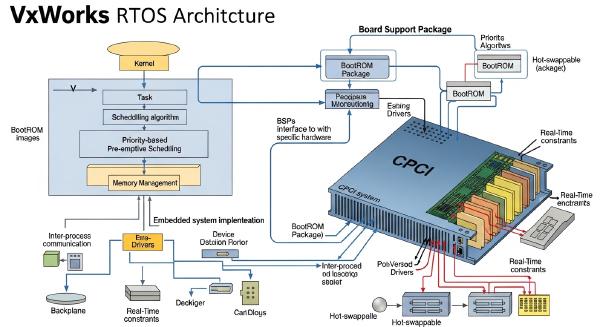
One of the defining characteristics of VxWorks 7 is its highly modular system architecture.
Unlike older monolithic RTOS designs, VxWorks 7 cleanly separates:
- Core kernel functionality
- Middleware packages
- Protocol stacks
- Drivers
- Security modules
- User applications
This design enables developers to tailor system footprints precisely to application requirements.
Benefits of a Modular RTOS #
The modular approach provides several important engineering advantages:
| Advantage | Impact |
|---|---|
| Reduced Footprint | Smaller runtime memory usage |
| Faster Integration | Easier feature composition |
| Lower Certification Scope | Smaller recertification boundaries |
| Simplified Maintenance | Independent package updates |
| Better Scalability | Support for both low-end and high-end systems |
This flexibility is particularly valuable for organizations maintaining broad product portfolios across multiple hardware tiers.
⚙️ Microkernel Flexibility and Unified Development #
VxWorks 7 supports both:
- Traditional high-performance RTOS deployments
- Small-profile microkernel configurations
Importantly, both operate within the same broader platform ecosystem.
This allows teams to standardize on a single operating system environment across:
- Constrained edge devices
- Intelligent gateways
- Industrial controllers
- High-performance embedded systems
Why This Matters #
Historically, companies often maintained multiple operating systems for different product classes, creating problems involving:
- Fragmented tooling
- Duplicate development effort
- Inconsistent APIs
- Separate certification paths
A unified platform significantly reduces long-term engineering complexity.
🔐 Security as a Core Architectural Requirement #
Security has become one of the defining challenges of modern embedded systems.
Connected devices dramatically increase attack surfaces through:
- Network exposure
- Remote management interfaces
- Wireless protocols
- OTA update mechanisms
- Third-party integrations
VxWorks 7 addresses this through a layered security architecture spanning the full device lifecycle.
Security Areas Covered #
The platform includes mechanisms supporting:
- Secure boot
- Runtime protection
- Memory isolation
- Access control
- Secure communications
- Lifecycle management
- Trusted execution environments
This is especially important in industries where compromise can affect:
- Human safety
- Critical infrastructure
- Defense systems
- Industrial operations
🧠 Memory Protection and Process Isolation #
A major advancement in VxWorks 7 is expanded support for MMU-based memory protection and user-mode execution.
Earlier RTOS deployments often operated entirely in kernel space for performance simplicity. While efficient, this approach increased system-wide failure risk because a fault in one application could potentially compromise the entire system.
VxWorks 7 introduces stronger process isolation models.
Key Reliability Improvements #
The platform now supports:
- User-space applications
- Process-based execution
- Protected memory domains
- Fault containment
- Controlled privilege separation
This improves:
- System robustness
- Fault isolation
- Security hardening
- Certification support
Particularly in complex IoT systems running multiple software components simultaneously, process isolation becomes critical for maintaining long-term reliability.
⏱️ Deterministic Real-Time Scheduling #
Despite its modern architectural improvements, VxWorks 7 remains fundamentally a hard real-time operating system.
Deterministic execution continues to be one of its defining characteristics.
Core Real-Time Features #
VxWorks 7 maintains support for:
- Priority-based preemptive scheduling
- Fast interrupt handling
- Low context-switch latency
- Time partitioning
- Deterministic task execution
Time partitioning is especially important in mixed-criticality systems where lower-priority workloads must never interfere with safety-critical operations.
This capability is essential in environments such as:
- Avionics
- Automotive systems
- Medical devices
- Industrial automation
- Defense platforms
🖥️ Multi-Core Support and System Consolidation #
Modern embedded processors increasingly rely on multi-core architectures to balance performance and power efficiency.
VxWorks 7 includes advanced support for:
- Symmetric multiprocessing (SMP)
- Asymmetric multiprocessing (AMP)
- Multi-core scheduling
- Core affinity management
Why Multi-Core Matters in Embedded Systems #
Multi-core support enables system consolidation, allowing multiple workloads to operate on fewer physical hardware platforms.
Benefits include:
- Reduced SWaP requirements
- Lower hardware complexity
- Improved power efficiency
- Better thermal characteristics
- Simplified deployment architectures
This is particularly important in aerospace, automotive, and industrial systems where physical space and power budgets remain constrained.
🌍 Broad Connectivity for Industrial IoT #
Connectivity is central to modern embedded infrastructure.
VxWorks 7 includes extensive support for networking and peripheral communication standards commonly used in industrial and IoT environments.
Supported Connectivity Technologies #
Examples include:
- TCP/IP networking
- USB
- CAN bus
- Bluetooth
- Industrial communication protocols
- Legacy integration interfaces
This enables organizations to modernize older embedded systems while maintaining compatibility with existing operational environments.
The modular networking architecture also allows selective inclusion of protocol stacks to optimize system footprint and certification boundaries.
🏭 Certification and Safety-Critical Deployment #
One of VxWorks’ strongest competitive advantages remains its history in certified environments.
VxWorks 7 continues supporting industries requiring compliance with rigorous standards such as:
- DO-178C (Aerospace)
- ISO 26262 (Automotive)
- IEC 61508 (Industrial Safety)
- Medical device certification frameworks
Why Certification Support Matters #
In safety-critical industries, operating system selection is not based solely on technical capability.
Certification readiness affects:
- Development timelines
- Regulatory approval
- System architecture decisions
- Long-term maintenance costs
A mature RTOS with established certification artifacts significantly reduces project risk.
🔄 Backward Compatibility and Investment Protection #
Embedded systems often remain deployed for decades.
As a result, backward compatibility is critically important.
VxWorks 7 was designed to preserve customer investment by maintaining strong compatibility with previous VxWorks generations.
Compatibility Advantages #
The platform supports:
- Legacy APIs
- Existing BSPs
- Prior drivers
- Older application codebases
Many systems developed for:
- VxWorks 5.5
- VxWorks 6.x
- Earlier Wind River ecosystems
can migrate with relatively limited modification effort.
This reduces:
- Rewrite costs
- Validation overhead
- Certification disruption
- Operational risk
🛠️ Development Environment and Tooling #
VxWorks 7 integrates with Wind River Workbench, an Eclipse-based embedded development environment.
Workbench provides:
- C/C++ development tooling
- System visualization
- Performance tracing
- Remote debugging
- Multi-core analysis
- Target communication frameworks
Advanced debugging and tracing tools are especially valuable in real-time environments where timing behavior and concurrency issues can be difficult to reproduce.
📊 Supported Architectures and Hardware Scalability #
VxWorks 7 supports a broad range of processor architectures commonly used in embedded systems.
Supported Architectures Include #
- ARM
- x86 / Intel 64-bit
- PowerPC
- QorIQ platforms
This flexibility enables deployment across:
- Lightweight IoT devices
- Industrial controllers
- Telecom systems
- Aerospace hardware
- Defense platforms
- Intelligent edge infrastructure
🚀 Why VxWorks 7 Remains Relevant #
Despite growing competition from embedded Linux and open-source RTOS platforms, VxWorks remains highly relevant in environments requiring:
- Hard real-time guarantees
- Safety certification
- Deterministic scheduling
- Long-term reliability
- Strong vendor support
The shift toward connected edge computing actually increases the importance of these capabilities.
As embedded systems become more intelligent and interconnected, balancing:
- Connectivity
- Security
- Isolation
- Real-time performance
becomes increasingly difficult.
VxWorks 7 was architected specifically around that convergence.
📌 Conclusion #
VxWorks 7 represents a substantial evolution of the traditional real-time operating system model for the modern IoT and edge computing era.
Its combination of:
- Modular architecture
- Deterministic scheduling
- Multi-core scalability
- Advanced security
- Process isolation
- Certification readiness
positions it as a strong platform for modern embedded development.
The platform’s flexibility allows organizations to deploy a unified RTOS strategy across a wide range of device classes while preserving long-term maintainability and backward compatibility.
For industries where reliability, predictability, and safety remain non-negotiable, VxWorks 7 continues to provide one of the most mature and capable commercial RTOS environments available.