
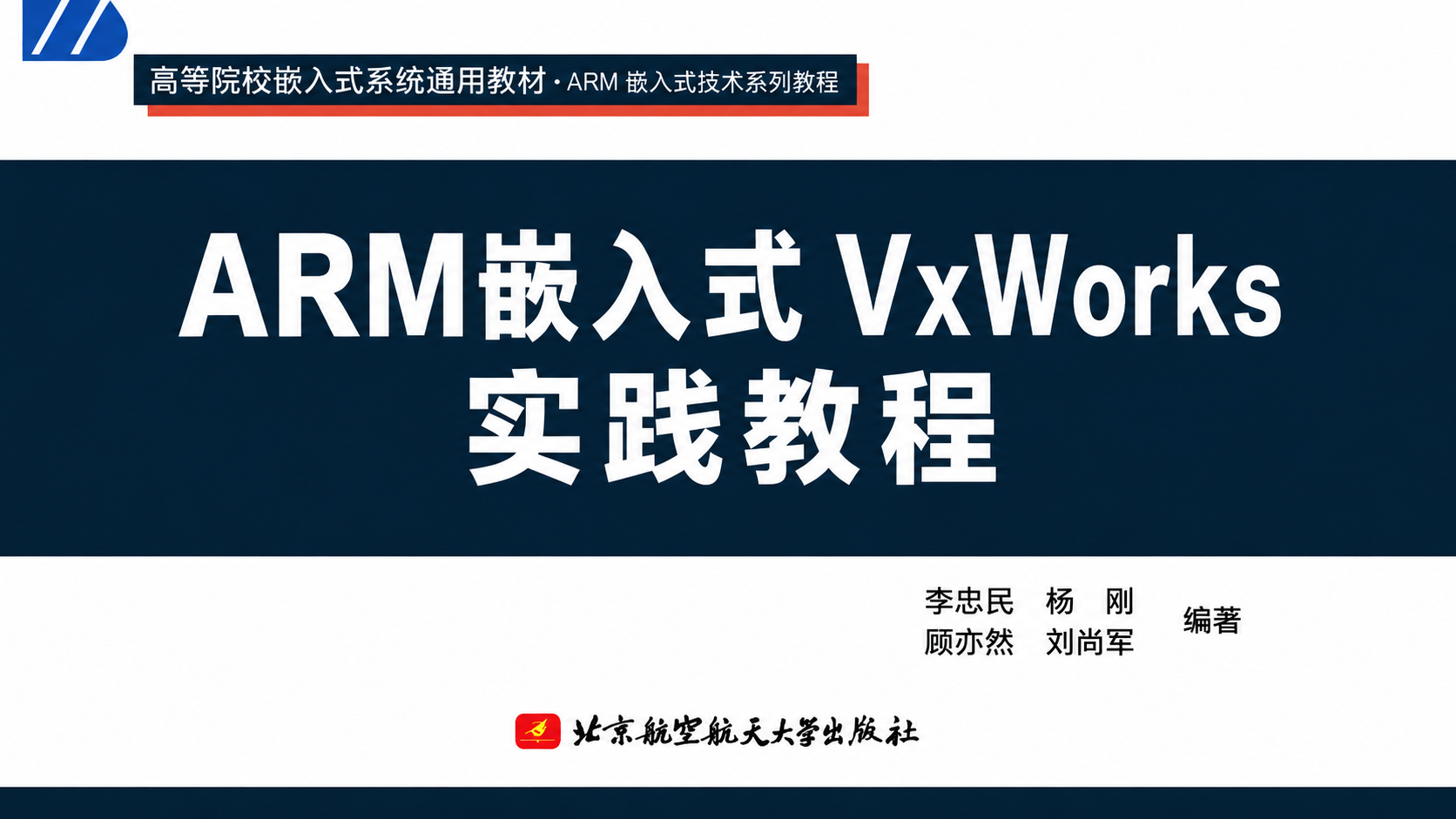
ARM VxWorks Embedded Systems Practical Tutorial Guide
📘 Overview #
This book is part of the ARM Embedded Technology Series Tutorials. It provides a hands-on introduction to developing embedded systems using VxWorks on ARM platforms, with a strong focus on real-world engineering workflows.
Using the JX2410 experimental platform and the S3C2410 processor, the material walks through the complete embedded system lifecycle: development environment setup, BSP porting, driver implementation, and application-level development. It also demonstrates debugging workflows using Wind River’s Tornado II IDE.
The content is suitable both as a structured learning path for beginners and as a technical reference for experienced VxWorks engineers.
🧠 Embedded Systems & ARM Architecture #
This section introduces foundational concepts required for embedded development:
Embedded Systems Fundamentals #
- Embedded system evolution and industry trends
- Key concepts and system classification
- Application domains of embedded systems
- Overview of embedded operating systems
ARM Processor Architecture #
- ARM application scenarios and core characteristics
- Processor operating modes and register organization
- Program Status Registers (CPSR/SPSR)
- Exception handling mechanism
- Interrupt vectors and system response flow
🛠️ Tornado II Development Environment #
This section covers Wind River’s Tornado II IDE used for VxWorks development:
Environment Setup and Project Management #
- Installation and configuration of Tornado II
- Project creation and management workflow
- Build system structure and compilation process
Debugging Toolchain #
- Integrated simulator
- Target server architecture
- Debug command-line interpreter
- Source-level debugger
- Target browser and system inspection tools
- Software logic analyzer for runtime tracing
🔧 BSP Porting on VxWorks #
Board Support Package (BSP) adaptation is a core part of embedded OS integration:
Kernel and BSP Fundamentals #
- VxWorks kernel characteristics
- BSP structure and file organization
- Boot process analysis
BSP Porting Workflow #
- Makefile configuration
- Kernel configuration management
- ROM-based boot initialization
- Timer subsystem implementation
- Interrupt handling design and integration
BSP Debugging and Optimization #
- Component-based system configuration
- Debugging techniques for low-level hardware bring-up
⚙️ Device Driver Development #
This section focuses on implementing hardware abstraction layers for embedded devices.
Driver Architecture Overview #
- Character, block, serial, and network driver models
- Data consistency and concurrency considerations
Key Driver Implementations #
- Keyboard driver (character device model)
- RAMDISK driver (block device model)
- S3C2410 serial communication driver
- RTL8019 network interface driver
File System Support #
- TSFS (Target Server File System)
- dosFS compatibility layer
- TrueFFS flash file system integration
🚀 VxWorks Application Programming #
This section covers real-time application development on VxWorks:
Task and Process Management #
- Task creation and scheduling mechanisms
- Shared and reentrant code design
- System task architecture and lifecycle
Inter-Task Communication #
- Shared memory communication
- Mutual exclusion mechanisms
- Semaphore synchronization
- Message queues and pipes
System Services #
- Watchdog timer management
- Interrupt handling in user applications
- Socket-based network communication
- Exception handling and error recovery strategies
📎 Appendix & References #
ARM Instruction Set #
- Overview of ARM microprocessor instruction architecture
- Reference materials for low-level programming
This tutorial provides a complete workflow from hardware initialization to full application development, making it a practical reference for real-world VxWorks embedded system projects.