
VxWorks Device Drivers and Distributed Programming
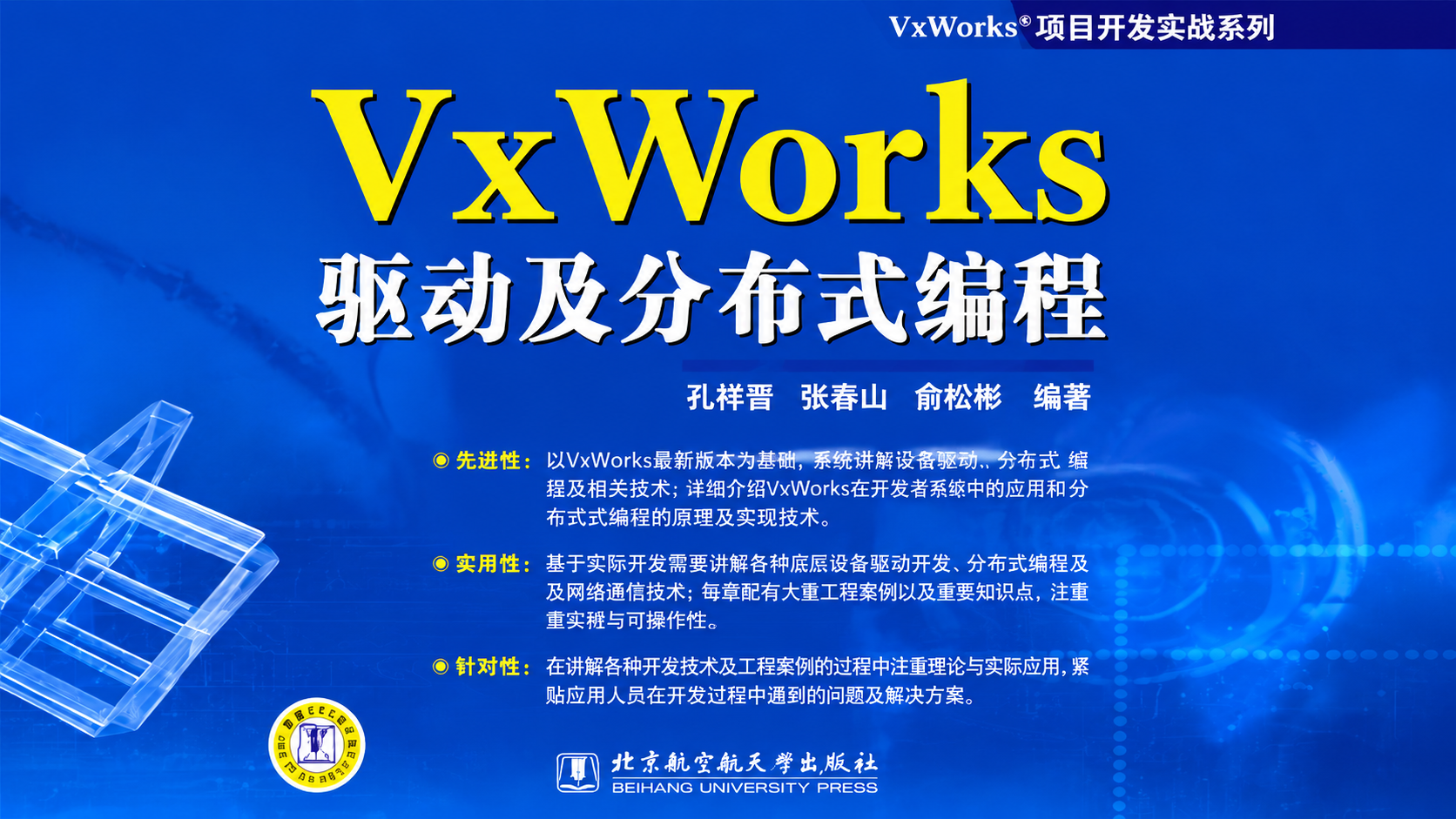
🧩 Embedded Driver Architecture and Distributed Systems Overview #
VxWorks is a real-time operating system widely used in embedded environments that require deterministic performance and reliable hardware integration. This work focuses on two major domains within the VxWorks ecosystem:
- Device driver development (character devices, network drivers, and graphics subsystems)
- Distributed programming models (DCOM and CORBA-based architectures)
Together, these areas extend VxWorks beyond a single-node RTOS into a networked, distributed embedded computing platform.
🔧 Device Driver Development in VxWorks #
Device drivers form the critical interface between the operating system and hardware components. In VxWorks, drivers are designed to ensure low-latency, deterministic I/O handling suitable for real-time constraints.
Character Device Drivers #
Character drivers handle stream-oriented I/O operations such as serial ports and simple input/output devices.
Core responsibilities include:
- Device initialization and registration with the kernel
- Read/write interface implementation
- Interrupt handling and buffering
- Synchronization for concurrent access
These drivers typically operate in either interrupt-driven or polling modes depending on hardware requirements.
END Network Drivers (Enhanced Network Driver Model) #
The END driver model is VxWorks’ architecture for network interface integration.
Key features include:
- Standardized network stack integration
- Support for Ethernet and custom network hardware
- Efficient packet buffering and DMA handling
- Low-latency interrupt-driven packet processing
END drivers are essential for enabling real-time networking in embedded systems such as routers, aerospace communication modules, and industrial controllers.
🖥️ Graphics Systems and Embedded GUI Integration #
WindML and Localization Support #
WindML provides a multimedia and graphics abstraction layer for VxWorks systems.
Key capabilities include:
- 2D graphics rendering support
- Input device handling (touch, keyboard, pointer devices)
- Localization and font rendering (including Chinese font libraries)
Microwindows Porting #
Microwindows (Nano-X) can be ported to VxWorks to enable lightweight graphical user interfaces in constrained environments.
Porting typically involves:
- Adapting system calls to VxWorks APIs
- Configuring framebuffer or display drivers
- Integrating input event handling
- Ensuring real-time responsiveness in UI rendering
These technologies enable embedded systems to support GUI-based interaction without requiring full desktop operating systems.
🌐 Distributed Programming in Embedded Systems #
VxWorks extends beyond single-node execution through distributed computing frameworks.
VxCOM / VxDCOM #
VxCOM and VxDCOM implement distributed component models based on Microsoft’s COM/DCOM architecture.
Key concepts include:
- Remote procedure invocation between embedded nodes
- Interface-based component communication
- Binary-compatible object interaction model
- Network-transparent method calls
These systems allow embedded devices to behave as interconnected software components in a distributed network.
CORBA in Real-Time Systems #
CORBA (Common Object Request Broker Architecture) provides a language- and platform-independent model for distributed object communication.
In VxWorks environments, CORBA supports:
- Object Request Broker (ORB) communication
- Cross-platform interoperability
- Real-time distributed service invocation
- Structured interface definition via IDL (Interface Definition Language)
GIOP Protocol Layer #
The General Inter-ORB Protocol (GIOP) defines the communication standard used by CORBA systems.
It enables:
- Standardized message formatting between ORBs
- Cross-platform distributed communication
- Efficient request/response handling in embedded networks
🧠 System-Level Architecture Perspective #
VxWorks distributed systems can be viewed as a layered model:
- Application layer: embedded services and distributed components
- Middleware layer: CORBA / DCOM communication frameworks
- Driver layer: END and character device drivers
- Kernel layer: real-time scheduling and system services
- Hardware layer: embedded processors and peripherals
This architecture allows VxWorks systems to scale from single-device controllers to fully distributed embedded networks.
🛠️ Development and Integration Workflow #
Typical development steps include:
- Setting up cross-compilation environments
- Configuring device drivers and BSP components
- Integrating network and communication stacks
- Developing distributed components (DCOM/CORBA)
- Testing inter-device communication in real-time conditions
Debugging distributed systems often requires synchronized logging and network-level tracing across multiple nodes.
📚 Application Domains #
This combination of driver-level and distributed programming capabilities is used in:
- Aerospace and satellite communication systems
- Industrial distributed control systems
- Network infrastructure devices (routers, switches)
- Embedded multimedia platforms
- Defense and mission-critical communication networks
🧾 Conclusion #
VxWorks Device Drivers and Distributed Programming extends the RTOS beyond hardware-level control into networked, distributed computing environments.
By combining deterministic driver design with standardized distributed communication models such as CORBA and DCOM, developers can build scalable embedded systems that operate reliably across multiple nodes while maintaining real-time performance guarantees.