
VxWorks RTOS Tutorial: Architecture, Task Management, and Embedded Application Development
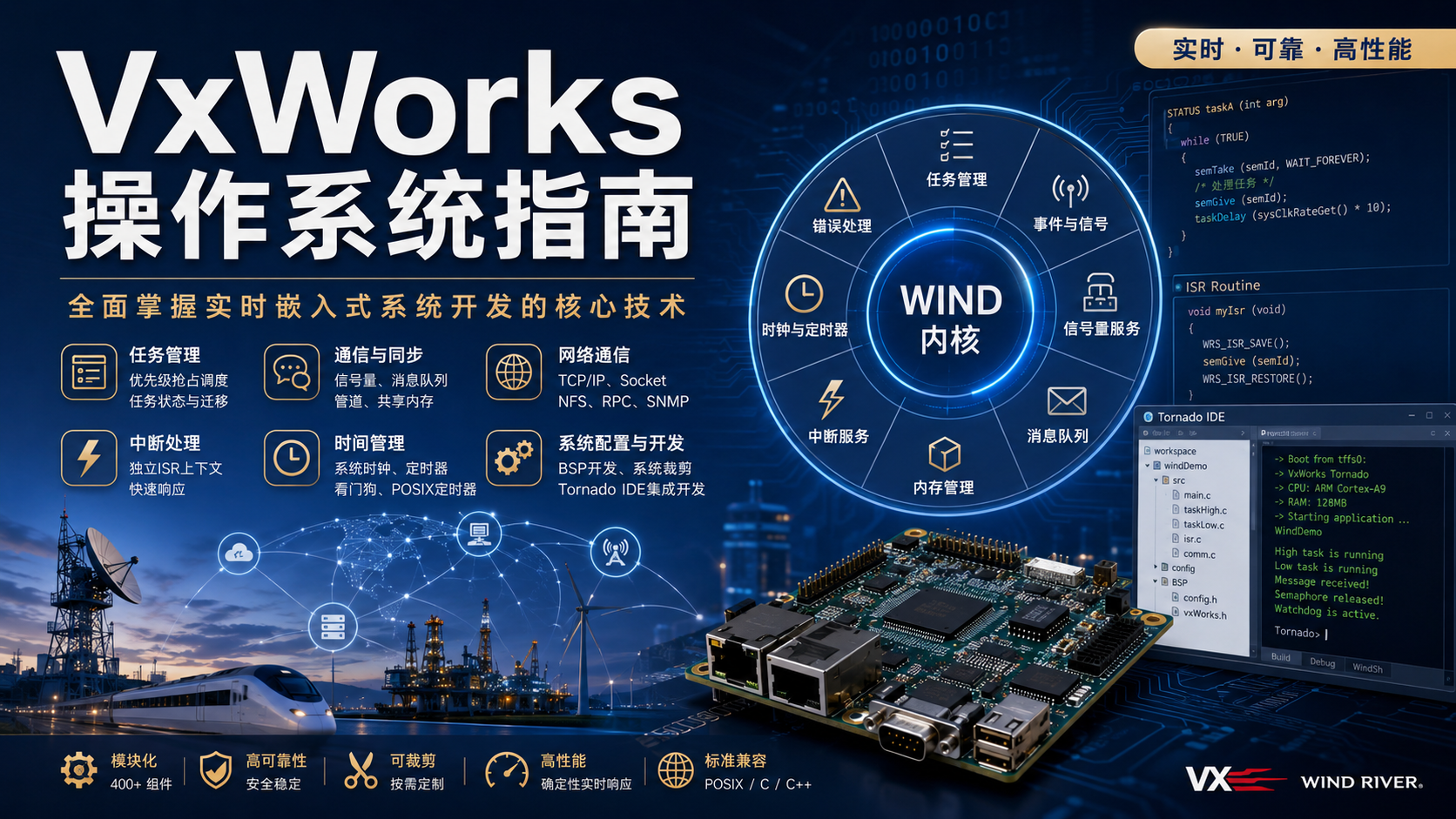
VxWorks is one of the industry’s most mature commercial real-time operating systems (RTOS), powering mission-critical applications across aerospace, defense, industrial automation, robotics, telecommunications, and medical devices. Its deterministic scheduler, modular architecture, and comprehensive development ecosystem have made it a long-standing choice for embedded systems that demand predictable timing and high reliability.
This tutorial provides a comprehensive overview of the VxWorks operating system, including its kernel architecture, task scheduling model, synchronization mechanisms, networking capabilities, interrupt handling, BSP development, and practical application design principles. Whether you’re developing embedded firmware or maintaining legacy VxWorks platforms, understanding these core concepts is essential for building reliable real-time systems.
🚀 Understanding VxWorks #
Developed by Wind River, VxWorks is a preemptive, multitasking RTOS engineered to provide deterministic response times under demanding workloads. Unlike general-purpose operating systems that optimize for throughput or user experience, VxWorks prioritizes predictable execution latency, making it suitable for hard and soft real-time applications.
Its architecture is highly configurable, allowing developers to include only the required system components, thereby minimizing memory footprint while maintaining performance.
Core Features #
- Priority-based preemptive scheduling
- Deterministic interrupt latency
- Modular kernel architecture
- POSIX compatibility
- ANSI C/C++ support
- Comprehensive networking stack
- Rich IPC mechanisms
- Extensive BSP support
- Commercial-grade debugging tools
These capabilities enable VxWorks to scale from compact embedded controllers to complex distributed real-time systems.
🏗️ Wind Kernel Architecture #
At the heart of VxWorks lies the Wind Kernel, responsible for coordinating task execution, scheduling, synchronization, memory management, and interrupt processing.
A simplified architecture is illustrated below.
                   +-----------------------------+
                   |       User Applications     |
                   +-----------------------------+
                               │
                               ▼
                +-------------------------------+
                |      VxWorks System APIs       |
                +-------------------------------+
                               │
                               ▼
                +-------------------------------+
                |        Wind Kernel            |
                +-------------------------------+
                | • Task Scheduler             |
                | • Semaphores                 |
                | • Message Queues             |
                | • Timers                     |
                | • Memory Management          |
                | • ISR Services               |
                +-------------------------------+
                               │
                               ▼
                +-------------------------------+
                | BSP & Hardware Drivers        |
                +-------------------------------+
                               │
                               ▼
                          Embedded Hardware
The kernel is intentionally lightweight, allowing applications to achieve deterministic execution with minimal overhead.
⚙️ Wind Kernel Responsibilities #
The Wind kernel provides several fundamental services:
- Task scheduling
- Context switching
- Interrupt handling
- Semaphore management
- Message queue services
- Memory allocation
- Event processing
- Clock and timer services
- Exception and error handling
These services collectively provide the execution environment for all real-time applications.
📋 Task Management #
In VxWorks, a task represents the smallest independently schedulable execution unit.
Each task executes independently and maintains its own runtime context inside a Task Control Block (TCB).
A TCB typically contains:
- Task ID
- Priority
- Stack pointer
- CPU registers
- Execution state
- Scheduling information
- Exception handling data
Because every task maintains its own execution context, VxWorks can rapidly switch between tasks while preserving program state.
🔄 Task Lifecycle #
Tasks transition through several execution states during their lifetime.
          +---------+
          | READY   |
          +---------+
               │
               ▼
          +---------+
          | RUNNING |
          +---------+
           │   │
     Delay │   │ Wait Resource
           ▼   ▼
      +---------+      +---------+
      | DELAY   |      | PEND    |
      +---------+      +---------+
            │              │
            └──────┬───────┘
                   ▼
                READY
The primary task states include:
| State | Description |
|---|---|
| READY | Waiting for CPU scheduling |
| RUNNING | Currently executing |
| PEND | Waiting on a synchronization object |
| DELAY | Sleeping for a specified duration |
| SUSPEND | Explicitly suspended by software |
Transitions occur through kernel APIs such as:
taskDelay()taskSuspend()taskResume()semTake()semGive()
⚡ Scheduling Policies #
VxWorks primarily employs priority-based preemptive scheduling.
Priority Scheduling #
Characteristics include:
- 256 priority levels
- Lower numerical value = higher priority
- Immediate preemption
- Deterministic scheduling behavior
Whenever a higher-priority task becomes READY, it immediately interrupts the currently executing lower-priority task.
This guarantees predictable response times for critical workloads.
Round-Robin Scheduling #
Tasks sharing identical priorities may optionally execute using time slicing.
Benefits include:
- Fair CPU utilization
- Reduced starvation
- Improved responsiveness among equal-priority tasks
💻 Common Task Management APIs #
VxWorks exposes a comprehensive set of APIs for managing tasks.
| API | Purpose |
|---|---|
taskSpawn() |
Create and immediately start a task |
taskInit() |
Initialize a task |
taskActivate() |
Activate an initialized task |
taskDelete() |
Terminate a task |
taskSuspend() |
Suspend execution |
taskResume() |
Resume execution |
taskPrioritySet() |
Modify scheduling priority |
Example: Creating a Task #
#include <vxWorks.h>
#include <taskLib.h>
#include <stdio.h>

void workerTask(int arg)
{
    while (1)
    {
        printf("Worker running...\n");
        taskDelay(sysClkRateGet());
    }
}

STATUS createTask(void)
{
    int tid = taskSpawn(
        "tWorker",
        100,
        0,
        8192,
        (FUNCPTR)workerTask,
        0,0,0,0,0,0,0,0,0,0);

    return (tid == ERROR) ? ERROR : OK;
}
This example creates a task with priority 100, allocates an 8 KB stack, and periodically executes once per system clock interval.
🔒 Inter-Task Communication and Synchronization #
Real-time systems often consist of multiple concurrent tasks that must exchange data safely.
VxWorks provides several IPC mechanisms.
| Mechanism | Primary Purpose |
|---|---|
| Shared Memory | High-speed data exchange |
| Semaphores | Synchronization |
| Mutex Semaphores | Mutual exclusion |
| Message Queues | Structured messaging |
| Pipes | Stream communication |
| Sockets | Network communication |
| RPC | Distributed execution |
Selecting the appropriate IPC mechanism depends on latency requirements, throughput, and synchronization complexity.
🛡️ Preventing Priority Inversion #
One common challenge in real-time systems is priority inversion, where a high-priority task becomes blocked by a lower-priority task holding a shared resource.
VxWorks addresses this through priority inheritance.
High Priority Task
        │
        ▼
   Waiting for Mutex
        ▲
        │
Low Priority Task
        │
Priority Inheritance
        ▼
Temporarily Elevated Priority
By temporarily raising the priority of the mutex owner, VxWorks minimizes blocking time and preserves deterministic scheduling behavior.
🌐 Networking Support #
VxWorks provides a mature networking stack compatible with BSD socket APIs.
Supported protocols include:
- TCP
- UDP
- IPv4
- IPv6
- NFS
- FTP
- Telnet
- SNMP
- RPC
Developers familiar with Berkeley sockets can typically port existing networking applications with minimal modification.
⚡ Interrupt Handling #
Interrupt Service Routines (ISRs) provide rapid responses to hardware events.
Best practices include:
- Keep ISRs as short as possible.
- Avoid dynamic memory allocation.
- Avoid lengthy computations.
- Signal worker tasks using semaphores or message queues.
- Return control quickly to minimize interrupt latency.
Typical ISR Workflow #
Hardware Interrupt
        │
        ▼
Interrupt Controller
        │
        ▼
ISR Executes
        │
        ▼
Semaphore Released
        │
        ▼
Worker Task Processes Event
Separating time-critical interrupt handling from longer processing tasks improves system responsiveness.
⏱️ Time Management #
VxWorks includes multiple timing facilities.
Common services include:
- System clock ticks
- Watchdog timers
- POSIX timers
- Periodic task scheduling
Frequently used watchdog APIs include:
WDOG_ID wdCreate();
STATUS wdStart();
STATUS wdCancel();
Watchdog timers are useful for implementing timeout detection, periodic monitoring, and fault recovery mechanisms.
🧩 Board Support Package (BSP) #
The Board Support Package (BSP) forms the hardware abstraction layer between the operating system and the target platform.
A BSP typically contains:
- CPU initialization
- Boot sequence
- Memory configuration
- Interrupt controller setup
- Clock initialization
- Console drivers
- Network interfaces
- Peripheral initialization
Because hardware varies significantly across embedded platforms, BSP development is often one of the most hardware-specific aspects of a VxWorks project.
🛠️ Application Development with Tornado #
Tornado serves as Wind River’s integrated cross-development environment.
Major components include:
- Source editor
- Cross compiler
- Linker
- CrossWind debugger
- WindSh shell
- Target Server
- VxSim simulator
- Object browser
Typical Development Workflow #
Configure BSP
       │
       ▼
Build Boot ROM
       │
       ▼
Generate VxWorks Image
       │
       ▼
Download to Target
       │
       ▼
Debug Application
       │
       ▼
Generate Production Image
This workflow enables rapid iteration while maintaining full visibility into target execution.
💡 Best Practices for VxWorks Development #
When developing production-grade real-time software, consider the following recommendations:
- Assign priorities according to task criticality.
- Minimize execution time inside ISRs.
- Protect shared resources using mutex semaphores.
- Avoid unnecessary dynamic memory allocation.
- Design tasks with clear responsibilities.
- Prevent deadlocks through consistent resource acquisition order.
- Prefer local variables over shared globals whenever possible.
- Carefully size task stacks based on workload characteristics.
These practices improve system reliability, maintainability, and real-time performance.
📄 Example Application Architecture #
A typical VxWorks application may consist of several coordinated tasks.
             +----------------+
             | Main Task      |
             +----------------+
                 │
      ┌──────────┼──────────┐
      ▼          ▼          ▼
 Sensor      Communication  Logger
  Task          Task         Task
      │          │          │
      └──────────┼──────────┘
                 ▼
          Message Queue
                 │
                 ▼
          Storage / Network
Each task focuses on a dedicated responsibility, while synchronization primitives coordinate execution between them.
This modular architecture simplifies debugging and improves scalability.
📚 Conclusion #
VxWorks remains one of the most capable commercial real-time operating systems for embedded applications that demand deterministic execution, low interrupt latency, and long-term reliability. Its modular Wind kernel, efficient priority-based scheduler, rich synchronization primitives, comprehensive networking support, and mature development ecosystem have made it a proven platform across aerospace, industrial automation, telecommunications, robotics, and defense.
Mastering VxWorks requires more than understanding individual APIs—it involves designing systems that balance responsiveness, concurrency, synchronization, and hardware interaction. By combining solid task architecture, disciplined interrupt handling, effective IPC mechanisms, and well-designed BSPs, developers can build scalable, high-performance embedded applications capable of meeting the stringent timing requirements of modern real-time systems.