
Embedded Software Design with VxWorks: Architecture, RTOS Concepts, and Practical Development
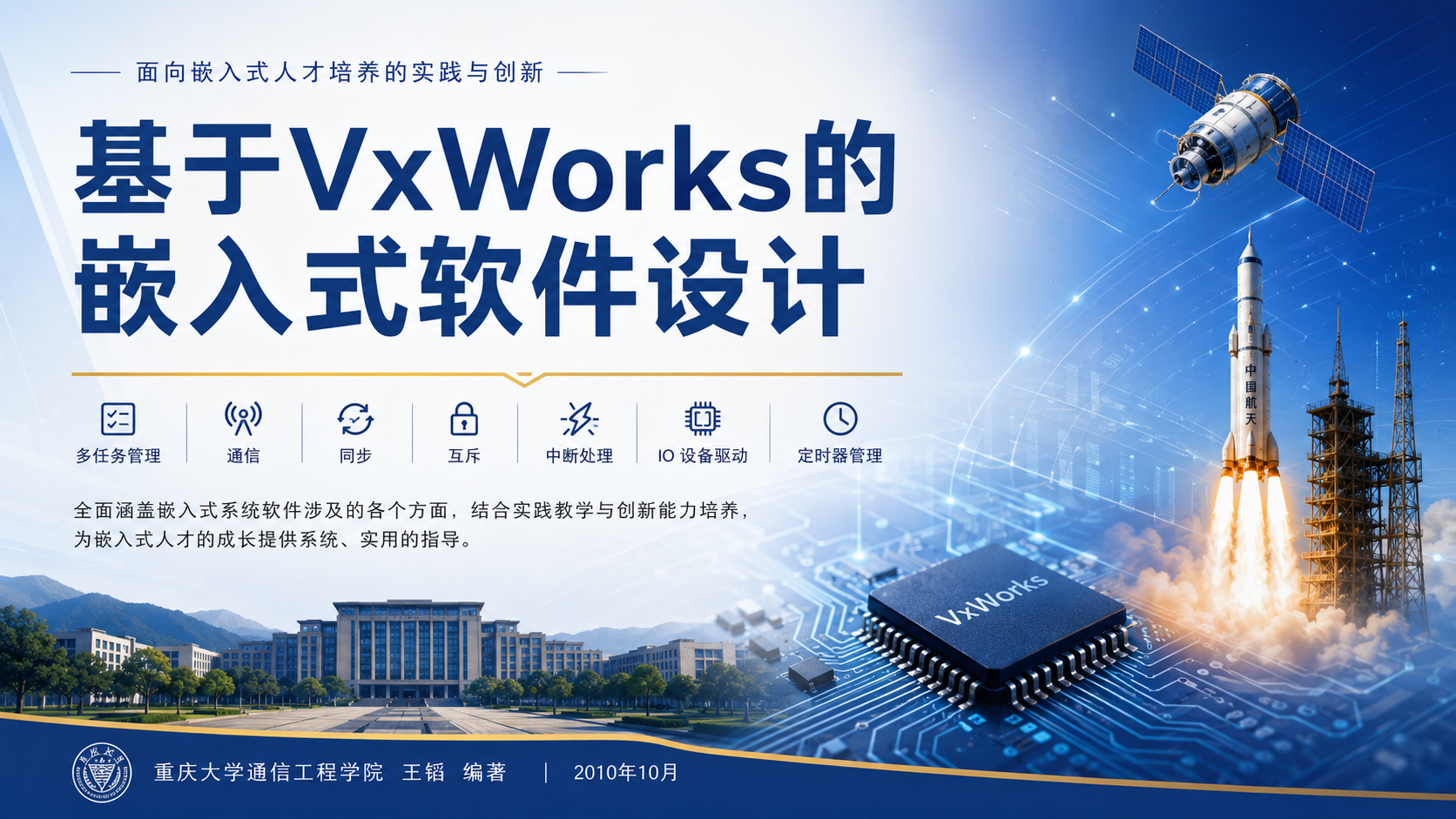
Embedded systems power nearly every modern industry, from aerospace and industrial automation to telecommunications, robotics, and medical devices. At the heart of these systems lies the Real-Time Operating System (RTOS), responsible for deterministic scheduling, hardware abstraction, and reliable execution under strict timing constraints.
Among commercial RTOS platforms, VxWorks, developed by Wind River, has established itself as one of the industry’s most mature and widely deployed operating systems. Its deterministic scheduler, modular architecture, extensive networking capabilities, and proven reliability have made it a preferred choice for mission-critical applications ranging from spacecraft and missile guidance systems to industrial controllers and networking equipment.
This guide provides a structured overview of embedded software development using VxWorks and the Tornado Integrated Development Environment (IDE). It covers both architectural concepts and practical implementation, including multitasking, synchronization, interrupt handling, timer management, device drivers, and system initialization.
🚀 Understanding Embedded Systems #
An embedded system is a specialized computing platform designed to perform dedicated functions within a larger system. Unlike general-purpose computers, embedded devices are optimized for specific workloads, emphasizing reliability, deterministic timing, low power consumption, and hardware efficiency.
Typical embedded systems combine:
- A processor or microcontroller
- Memory
- Peripheral interfaces
- Sensors and actuators
- An embedded operating system (optional)
The operating system coordinates hardware resources while providing services such as scheduling, memory management, networking, and device communication.
Evolution of Embedded Systems #
Embedded computing has progressed through several generations.
| Generation | Characteristics |
|---|---|
| Early Systems | Single-chip microcontrollers performing simple control logic |
| Intermediate Systems | 8-bit and 16-bit processors with lightweight operating systems |
| Modern Systems | 32-bit and 64-bit processors running sophisticated RTOS platforms with networking and advanced peripherals |
Today, embedded processors commonly include architectures such as:
- ARM
- PowerPC
- MIPS
- RISC-V
- DSP processors
- x86 (selected industrial applications)
These platforms rely on RTOS software to satisfy strict real-time constraints.
⚙️ Why Real-Time Operating Systems Matter #
Unlike desktop operating systems, an RTOS prioritizes predictable timing over maximum throughput.
Tasks must complete within deterministic deadlines.
This is especially important for systems such as:
- Flight control computers
- Autonomous vehicles
- Industrial robotics
- Medical equipment
- Telecommunications infrastructure
- Defense systems
Typical RTOS capabilities include:
- Priority-based scheduling
- Fast interrupt response
- Low context-switch latency
- Deterministic synchronization
- Memory protection
- Hardware abstraction
VxWorks has become one of the industry’s benchmark RTOS platforms because of these characteristics.
🏗️ VxWorks Architecture #
Originally introduced by Wind River in 1983, VxWorks follows a modular architecture that allows developers to include only the components required by a specific application.
Its primary components include:
+--------------------------------------+
| User Applications                    |
+--------------------------------------+
| Networking | File Systems | Drivers  |
+--------------------------------------+
| VxWorks Kernel Services              |
+--------------------------------------+
| BSP (Board Support Package)          |
+--------------------------------------+
| Hardware Platform                    |
+--------------------------------------+
This layered design simplifies portability while minimizing resource consumption.
🧩 Core Components of VxWorks #
Wind Kernel #
The Wind Kernel is the core execution engine of VxWorks.
Its responsibilities include:
- Priority scheduling
- Context switching
- Interrupt processing
- Task synchronization
- Memory management
- Timer services
The kernel is designed for extremely low scheduling latency while maintaining deterministic behavior.
Board Support Package (BSP) #
Every hardware platform requires a Board Support Package (BSP).
The BSP abstracts board-specific functionality such as:
- CPU initialization
- Memory mapping
- Interrupt controllers
- Timers
- Device initialization
- Boot configuration
Because applications interact with standardized kernel APIs rather than hardware directly, software portability improves significantly.
Networking Stack #
VxWorks provides a mature TCP/IP networking implementation supporting protocols including:
- TCP
- UDP
- RIP
- FTP
- Telnet
- NFS
- Berkeley Sockets
This enables embedded systems to participate in distributed and networked environments with minimal customization.
File Systems #
Several file system implementations are available depending on application requirements.
Common options include:
- dosFs
- rawFs
- rt11Fs
- tapeFs
Applications can select only the required modules to reduce memory usage.
Inter-Task Communication #
VxWorks provides multiple synchronization mechanisms including:
- Binary semaphores
- Counting semaphores
- Mutex semaphores
- Message queues
- Pipes
- Shared memory
- Signals
- Sockets
These primitives form the foundation of concurrent application development.
⭐ Key Features of VxWorks #
Several characteristics distinguish VxWorks from many embedded operating systems.
Deterministic Scheduling #
The scheduler supports:
- 256 priority levels
- Preemptive scheduling
- Round-robin execution
- Fast context switching
Higher-priority tasks immediately preempt lower-priority tasks whenever necessary.
Scalability #
One of VxWorks’ greatest strengths is configurability.
Minimal systems may occupy only a few kilobytes of ROM, while enterprise deployments can include:
- Networking
- File systems
- POSIX APIs
- Security modules
- Virtualization
- SMP support
This flexibility allows the same operating system to serve vastly different hardware platforms.
Reliability #
VxWorks has accumulated decades of deployment experience in safety-critical environments including:
- Aerospace
- Defense
- Industrial automation
- Medical instrumentation
- Telecommunications
Its deterministic architecture makes it suitable for applications where software failures are unacceptable.
🛠️ Developing with Tornado IDE #
Tornado was Wind River’s integrated development environment for VxWorks development.
The IDE runs on a host workstation while communicating with the embedded target through:
- Ethernet
- Serial connections
- JTAG
- Hardware emulators
Its architecture separates application development from target execution.
Major Components #
The development environment includes:
- Source code editor
- Project manager
- Cross-compilers
- Incremental loader
- CrossWind graphical debugger
- WindSh command shell
- VxSim simulator
- System browser
- Configuration utilities
Together these tools provide a complete embedded development workflow.
🔄 Typical Development Workflow #
A standard VxWorks development cycle consists of several stages.
Develop Source Code
          │
          ▼
Cross Compilation
          │
          ▼
Generate Boot ROM
          │
          ▼
Build VxWorks Image
          │
          ▼
Download to Target
          │
          ▼
Debug and Test
          │
          ▼
Generate Production Image
Typical activities include:
- Configure the BSP.
- Build the Boot ROM.
- Configure networking.
- Create the VxWorks image.
- Download application modules.
- Debug using CrossWind or WindSh.
- Produce the final ROM image.
🧵 Task Management #
Multitasking is one of VxWorks’ core capabilities.
Each task executes independently under the kernel scheduler.
Task creation is typically performed using taskSpawn().
STATUS taskSpawn(
    char *name,
    int priority,
    int options,
    int stackSize,
    FUNCPTR entryPt,
    ...
);
Typical task states include:
- READY
- PEND
- DELAY
- SUSPEND
- RUNNING
The scheduler continuously selects the highest-priority runnable task.
📨 Inter-Task Communication #
Independent tasks must exchange information safely.
VxWorks supports multiple communication mechanisms.
| Mechanism | Best Use Case |
|---|---|
| Shared Memory | High-speed data exchange |
| Message Queues | Structured task communication |
| Pipes | Stream-oriented communication |
| Signals | Event notification |
| Sockets | Network communication |
Example: Message Queue #
MSG_Q_ID msgQ;

msgQ = msgQCreate(
    32,
    sizeof(int),
    MSG_Q_PRIORITY
);
Message queues provide deterministic communication while avoiding busy waiting.
🔒 Task Synchronization #
Concurrent execution introduces synchronization challenges.
VxWorks provides three primary semaphore types:
- Binary semaphore
- Counting semaphore
- Mutex semaphore
Mutex semaphores implement priority inheritance, preventing priority inversion, one of the most common issues in real-time scheduling.
Example:
SEM_ID mutex;

mutex = semMCreate(
    SEM_Q_PRIORITY |
    SEM_INVERSION_SAFE
);
Priority inheritance temporarily raises the owner’s priority until the protected resource is released.
⚡ Interrupt Management #
Interrupt Service Routines (ISRs) provide immediate responses to hardware events.
A typical interrupt flow is:
Hardware Interrupt
         │
         ▼
Interrupt Controller
         │
         ▼
ISR
         │
         ▼
Semaphore / Event
         │
         ▼
Worker Task
ISRs should remain extremely short.
Best practices include:
- Avoid blocking operations.
- Minimize execution time.
- Defer complex processing to worker tasks.
- Signal application tasks using semaphores or message queues.
⏱️ Timer Management #
VxWorks provides several timing mechanisms.
Common timer services include:
- Watchdog timers
- Auxiliary clocks
- System clocks
- Periodic timers
Watchdog timers are frequently used to detect software failures.
Example:
WDOG_ID watchdog;

watchdog = wdCreate();

wdStart(
    watchdog,
    sysClkRateGet(),
    timeoutHandler,
    0
);
Timers enable periodic scheduling without busy polling.
💾 I/O Driver Development #
VxWorks follows a modular device-driver architecture.
Typical driver responsibilities include:
- Device initialization
- Open
- Close
- Read
- Write
- IOCTL operations
- Interrupt processing
A simplified driver structure resembles:
Application
      │
      ▼
I/O System
      │
      ▼
Device Driver
      │
      ▼
Hardware
Separating applications from hardware-specific implementation improves portability and maintainability.
🚀 System Initialization and Boot Process #
The VxWorks boot sequence follows several well-defined stages.
Power On
     │
     ▼
Boot ROM
     │
     ▼
Hardware Initialization
     │
     ▼
Kernel Startup
     │
     ▼
BSP Initialization
     │
     ▼
usrAppInit()
     │
     ▼
User Applications
The usrAppInit() function typically serves as the application’s primary initialization entry point.
Developers commonly initialize:
- Tasks
- Drivers
- Network interfaces
- Timers
- Communication services
during this stage.
🧪 Laboratory Exercises #
Practical experimentation is essential for mastering embedded software development.
Representative laboratory projects include:
- Task scheduling
- Message queue programming
- Semaphore synchronization
- Interrupt processing
- Timer applications
- Character device drivers
- System initialization
- Integrated multitasking applications
Typical hardware platforms include MPC860-based development boards or equivalent embedded targets.
These exercises reinforce both RTOS theory and practical engineering techniques.
📌 Best Practices for VxWorks Development #
When developing production-grade embedded applications, consider the following guidelines:
- Keep ISRs short and deterministic.
- Use mutex semaphores for shared resources.
- Assign task priorities based on timing requirements rather than functionality.
- Avoid dynamic memory allocation in hard real-time paths whenever possible.
- Separate hardware-specific code inside BSPs and drivers.
- Use message queues instead of shared memory when synchronization is required.
- Continuously monitor CPU utilization and stack usage during testing.
Following these practices significantly improves system reliability and maintainability.
📚 Conclusion #
VxWorks remains one of the most capable commercial real-time operating systems for embedded software development. Its deterministic scheduler, modular architecture, comprehensive networking stack, and mature development ecosystem have enabled decades of successful deployment across aerospace, industrial automation, defense, telecommunications, and other mission-critical domains.
Combined with the Tornado IDE, VxWorks provides a complete development environment covering the entire embedded software lifecycle—from Boot ROM generation and BSP configuration to multitasking, synchronization, interrupt management, device driver development, and production deployment.
For engineers seeking a deep understanding of RTOS design principles and real-world embedded software engineering, mastering VxWorks offers valuable experience in building reliable, deterministic, and high-performance embedded systems.