VxWorks Program Development Practice: Embedded RTOS Guide
🧩 Embedded Real-Time Operating System Development Overview #
VxWorks is a widely used real-time operating system (RTOS) designed for embedded systems requiring deterministic performance, multitasking capability, and tight hardware control. Developed by Wind River Systems, it is commonly used in aerospace, defense, industrial automation, and telecommunications.
This guide focuses on practical program development within the VxWorks environment, including system architecture, toolchain usage (notably the Tornado development environment), and core OS services required for building reliable embedded applications.
The development model emphasizes real-time constraints, task scheduling predictability, and efficient resource management under limited hardware conditions.
⚙️ Core VxWorks System Architecture #
VxWorks is built around a modular kernel architecture supporting preemptive multitasking and real-time scheduling.
Key system components include:
- Task management and scheduling
- Memory management subsystem
- I/O system abstraction layer
- File system integration
- Network communication stack
These components work together to provide deterministic execution behavior, which is essential for mission-critical embedded applications.
🧵 Multitasking and Real-Time Execution Model #
The VxWorks kernel supports multiple concurrent tasks with priority-based preemptive scheduling. Real-time responsiveness is achieved by ensuring high-priority tasks can interrupt lower-priority ones deterministically.
Typical multitasking features include:
- Priority-based scheduling
- Task synchronization primitives (semaphores, mutexes)
- Inter-task communication mechanisms
- Interrupt handling integration
This model allows developers to design systems where timing guarantees are as important as functional correctness.
🧠 Memory Management in Embedded Constraints #
Memory management in VxWorks is designed for predictable allocation and minimal fragmentation. Unlike general-purpose operating systems, emphasis is placed on:
- Deterministic memory allocation
- Static and dynamic memory partitioning
- Efficient heap management for real-time workloads
Proper memory design is critical to avoid latency spikes or unpredictable system behavior.
💾 I/O System and Device Abstraction #
The VxWorks I/O system provides a uniform interface for interacting with hardware devices.
Key features include:
- Character and block device support
- Device driver abstraction layer
- Standardized I/O APIs
- Stream-based communication model
This abstraction allows applications to interact with hardware without direct dependency on underlying device implementation.
📁 File System Support #
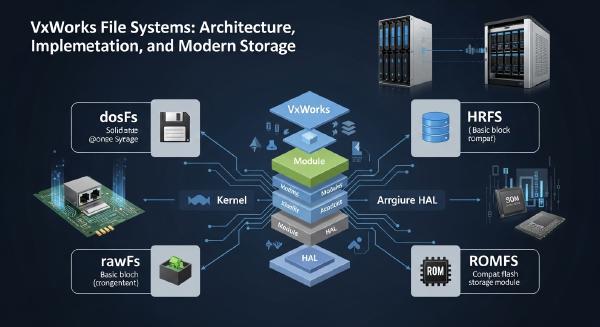
VxWorks supports multiple file system types depending on configuration and target hardware. These systems enable persistent storage management for embedded applications.
Common capabilities include:
- File creation and manipulation
- Directory management
- Flash and RAM-based file systems
- Network-based file access (in configured environments)
🌐 Network Communication Stack #
The built-in TCP/IP stack enables VxWorks systems to participate in networked environments.
Typical functionality includes:
- TCP/UDP socket communication
- Network interface configuration
- Protocol stack integration
- Remote diagnostics and control
This makes VxWorks suitable for distributed embedded systems requiring real-time communication.
🛠️ Development Environment and Toolchain #
The traditional VxWorks development workflow uses the Tornado IDE (and later Wind River Workbench in newer versions).
Development steps generally include:
- Setting up cross-compilation toolchains
- Configuring target hardware boards
- Building kernel images
- Deploying and debugging via host-target connection
📚 Chapter Structure Overview #
The material typically covers:
- Wind River ecosystem overview
- Tornado development environment
- VxWorks kernel fundamentals
- Multitasking environment design
- Memory management strategies
- I/O subsystem architecture
- File system implementation
- Network communication design
- Development environment setup
- Practical program development workflows
🧾 Conclusion #
VxWorks remains a foundational RTOS for high-reliability embedded systems. Its deterministic scheduling, modular architecture, and robust networking and I/O subsystems make it suitable for mission-critical applications.
Understanding its core subsystems—task scheduling, memory management, and device abstraction—is essential for building stable and efficient embedded software systems.