
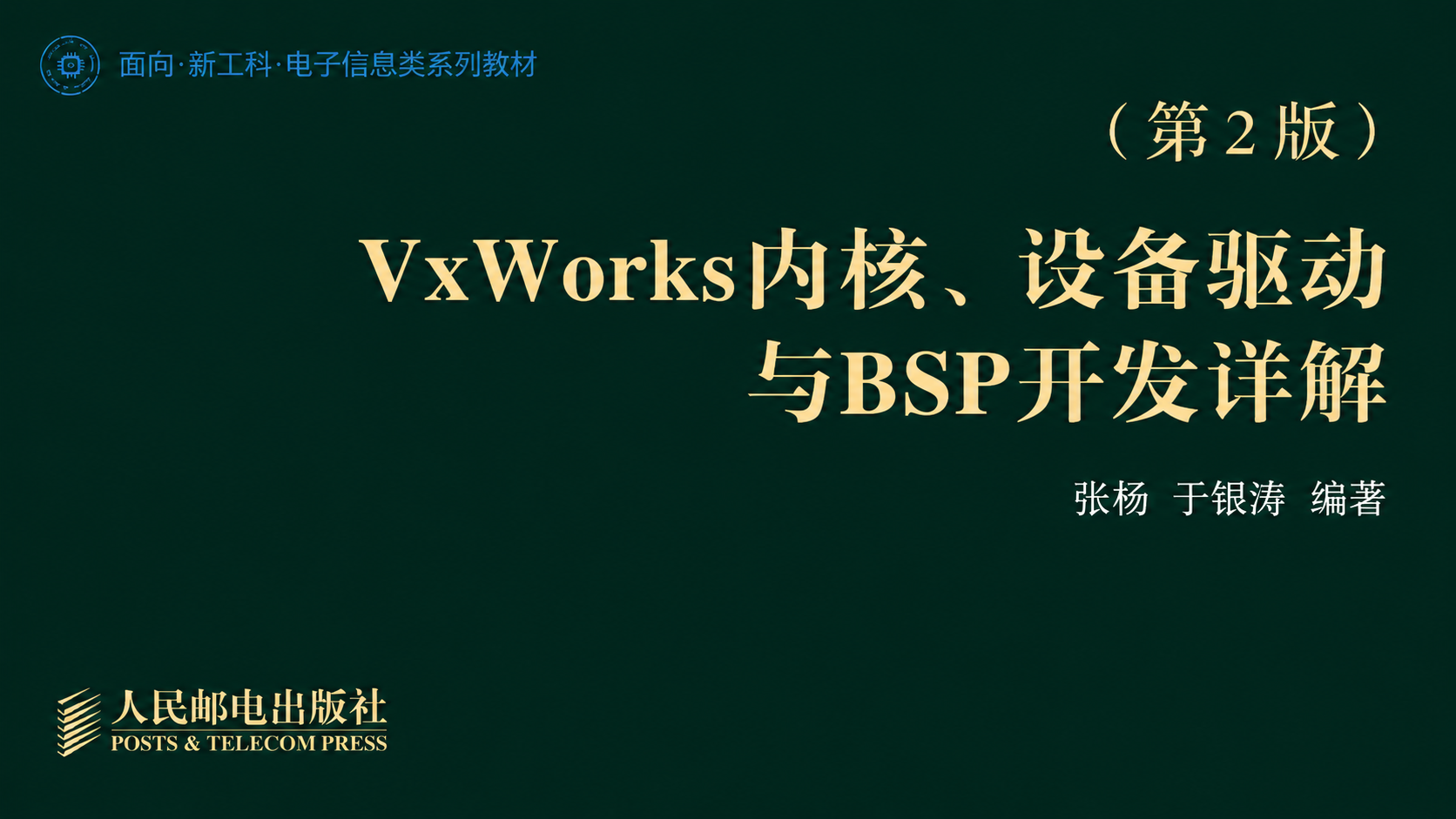
VxWorks Kernel, Device Drivers and BSP Development (2nd Edition)
🧠 Embedded RTOS Kernel Engineering Overview #
VxWorks is a high-performance real-time operating system widely used in mission-critical embedded systems, including aerospace, defense, industrial automation, and communications infrastructure. Its architecture is designed to provide deterministic scheduling, modular extensibility, and tight hardware control.
This second edition focuses on three core pillars of embedded system engineering within VxWorks:
- Kernel architecture and internal mechanisms
- Device driver design and implementation
- Board Support Package (BSP) development and porting
Together, these form the foundation for customizing VxWorks to specific hardware platforms.
⚙️ VxWorks Kernel Architecture and Internal Mechanisms #
The VxWorks kernel is a preemptive, priority-based real-time kernel optimized for predictable execution timing. It supports fine-grained multitasking and low-latency interrupt handling.
Key kernel-level components include:
- Task scheduling and context switching
- Interrupt service routines (ISR) handling
- Synchronization primitives (semaphores, mutexes, message queues)
- Memory partitioning and allocation strategies
- Real-time deterministic execution model
A central design principle is minimizing jitter and ensuring bounded execution time for high-priority tasks, which is critical in real-time systems.
🧵 Multitasking and Real-Time Scheduling Model #
VxWorks uses a priority-driven preemptive scheduling model where:
- Higher-priority tasks immediately preempt lower-priority tasks
- Equal-priority tasks may use round-robin scheduling
- Interrupts can trigger immediate task rescheduling
This structure ensures deterministic response times, making it suitable for control systems, avionics, and industrial automation.
🔧 Device Driver Development Model #
Device drivers in VxWorks serve as the abstraction layer between hardware devices and the operating system.
Core principles include:
- Hardware abstraction via standardized I/O interfaces
- Separation of driver logic from application logic
- Interrupt-driven or polling-based I/O handling
- Support for character, block, and network devices
Driver development typically involves:
- Initializing hardware registers
- Registering device interfaces with the OS
- Handling interrupts and buffering data streams
- Ensuring thread-safe access to shared resources
Well-designed drivers are essential for system stability and real-time performance.
🧩 BSP (Board Support Package) Development #
The Board Support Package (BSP) is the hardware adaptation layer that allows VxWorks to run on specific embedded platforms.
A BSP typically includes:
- Boot loader and initialization code
- CPU and chipset configuration
- Memory mapping and hardware resource definition
- Device driver integration
- Interrupt vector configuration
BSP development is essential when porting VxWorks to new hardware platforms. It bridges the gap between generic OS kernel and platform-specific hardware behavior.
🧠 Kernel–Hardware Interaction Layer #
The interaction between kernel, drivers, and BSP can be conceptualized as a layered architecture:
- Application layer: user programs and services
- Kernel layer: scheduling, memory, IPC, and system services
- Driver layer: device communication and hardware control
- BSP layer: hardware initialization and platform adaptation
Each layer depends on the stability and correctness of the layer beneath it, forming a tightly integrated real-time execution stack.
🛠️ Development and Debugging Workflow #
Typical VxWorks development workflow includes:
- Cross-compilation for target architecture
- BSP configuration and kernel image generation
- Booting via network or flash-based loader
- Debugging through host-target communication tools
- Iterative driver and kernel module testing
This workflow emphasizes tight integration between development host and embedded target system.
📚 Application Domains #
VxWorks with custom kernel and BSP configurations is commonly used in:
- Aerospace flight control systems
- Satellite and space communication systems
- Industrial robotics and automation
- Telecommunications infrastructure
- Medical embedded devices
These domains require high reliability, deterministic timing, and fault-tolerant execution.
🧾 Conclusion #
The second edition of VxWorks Kernel, Device Drivers and BSP Development provides a structured and practical approach to embedded system engineering at the OS level.
By understanding kernel internals, driver architecture, and BSP design principles, developers gain the ability to customize VxWorks for specialized hardware platforms and mission-critical applications where reliability and real-time performance are non-negotiable.